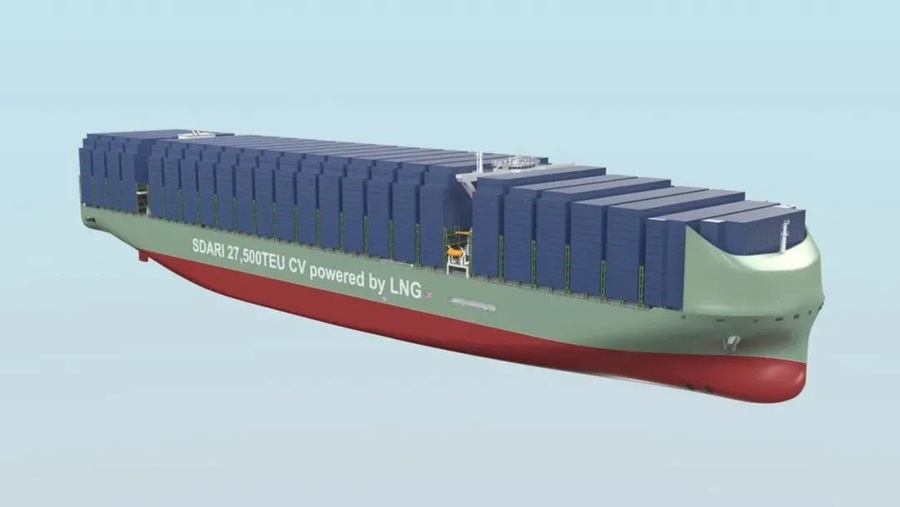
China State Shipbuilding Corp’s (CSSC) Shanghai Ship Research and Design Institute (SDARI) has set a new world record with a 27,500-TEU container ship design
CSSC-SDARI unveiled the design for a goliath container vessel, Green Sealion, on 3 September at the SMM maritime trade show in Hamburg, Germany.
If built, the 27,500-TEU container ship will set a new world record for the largest box ship on the water, at more than 3,000 TEU larger than the current largest box ships, a series of vessels delivered to MSC last year.
The Chinese company behind the design has received approval in principle (AiP) from classification society DNV for its planned vessel. The vessel plan includes LNG dual-fuel propulsion and a hull designed to meet IMO Phase III carbon reduction standards.
CSSC also received AiP certificates for four other designs, including a 20,000-TEU ammonia dual-fuel container ship, a 16,000-TEU LNG dual-fuel container ship, a 103,000-m3 very large ethane carrier, and a 93,000-m3 very large ammonia carrier.
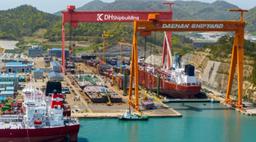
DNV awarded Huangpu Wenchong Shipbuilding Co three approval in principle certificates for their designs of three new ship types, an ammonia-fueled 43,000-m3 midsize gas carrier, an ammonia-fueled SWAN 3,500-TEU container ship, and a LNG dual-fueled SWAN 1,300-TEU container ship with ice classification.
The classification society also awarded Hudong Zhonghua Shipbuilding Co with three AiP certificates and a General Approval for Ship Application certificate for vessel designs, including a 150,000-m3 ultra large ethane carrier, a 40,000-m3 liquefied carbon dioxide carrier, and a 20,000-m3 LNG bunker vessel.
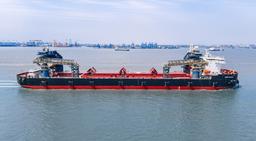
DNV also awarded shipping and logistics company Wallenius Wilhelmsen its first biofuel insetting verification statement - recognising the company’s use of B100 (100% biofuel) in a recent voyage. DNV worked with Wallenius Wilhelmsen to verify the greenhouse gas (GHG) reductions on the Morning Post vehicle carrier. The vessel bunkered the B100 biofuels, derived entirely from sustainable sources, at the port of Antwerp-Bruges in Belgium. The vessel burned the biofuel during a scheduled commercial voyage, reducing its GHG emissions by some 90% CO2 equivalent on well-to-wake basis. This statement is DNV’s first commercial verification of biofuel insetting with 100% biofuel.
Source: Riviera Maritime