New development opportunities for the shipbuilding industry are emerging from the green transformation process, which demands technological innovation, increased production capacity, and compliance with environmental standards. By seizing this trend, Vietnam's civil shipbuilding industry has the opportunity to participate more deeply in the global value chain, gradually mastering technology, developing supporting industries, and forming a modern marine industrial ecosystem.Tìm hiểu lịch sử
Aiming to master technology, techniques, and human resources.
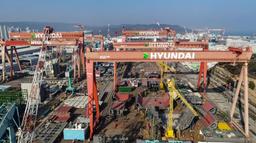
One of the outstanding projects undertaken by HD Hyundai Vietnam Shipbuilding Co., Ltd. (HVS) is the construction of the LR2 oil tanker, a dual-fuel LNG vessel incorporating rigid sail technology (Wind Wings), with a deadweight tonnage of 115,000 DWT. HVS leaders stated that this is an opportunity for the company to gain experience in fuel systems, equipment, safety, and production organization for clean fuel vessels.
Starting with ship repair, HVS transitioned to complete new shipbuilding in 2008 and has grown into one of the world's largest shipyards. To date, HVS has delivered 210 vessels, including cargo ships with a tonnage of up to 87,000 tons and oil tankers up to 115,000 tons, to customers in many countries around the world. As a joint venture between the Shipbuilding Industry Corporation (SBIC) and Hyundai Group ( Korea ), after nearly 30 years of operation, HVS is considered an effective and sustainable cooperation model, benefiting both parties.
New shipbuilding at HD Hyundai Vietnam Shipbuilding Co., Ltd. Photo provided by HVS.
According to Mr. Jin Sang Ho, General Director of HVS, emission reduction is becoming a long-term trend in the maritime industry and will impact the entire shipbuilding industry, from design, engineering, materials, equipment to production technology and energy efficiency. To gradually prepare for this trend, it is necessary to improve technological capabilities, train personnel, and access to ships with higher environmental requirements. HVS leaders assess that the current team of Vietnamese engineers, technicians, managers, and workers have many years of experience, not only following existing procedures but also knowing how to handle problems and proactively taking responsibility for their work.
Vietnamese civil shipbuilding units can participate more deeply in areas such as precision mechanics, steel structures, electrical equipment, automation, pipelines, valves, pumps, auxiliary equipment, and technical services. However, to penetrate the supply chain, businesses cannot simply stop at processing; they need to improve their technical capabilities, quality, schedule, and technology. Besides the goal of building ships with lower emissions, Vietnam must also aim to gradually gain more mastery of technology, engineering, human resources, and high-value products within the supply chain.
Promoting the formation of a marine industrial ecosystem.
The International Maritime Organization (IMO) aims for a significant reduction in greenhouse gas emissions by 2030, with the goal of achieving net-zero emissions around 2050. This is predicted to revolutionize the global shipbuilding industry with trends in green energy vessels such as LNG (liquefied natural gas), methanol, ammonia, hydrogen, hybrid electric vessels, fuel cell technology, energy-saving systems, and carbon capture technology. The green transition is seen as a new technological competition and industry standardization among countries with developed shipbuilding industries.
Resolution No. 36-NQ/TW of the Central Committee of the Communist Party of Vietnam on the Strategy for Sustainable Development of Vietnam's Marine Economy to 2030, with a vision to 2045, emphasizes the viewpoint that sustainable development of the marine economy should be based on green growth, biodiversity conservation, and marine ecosystems; ensuring harmony between economic and natural ecosystems, between conservation and development, and between the interests of coastal and non-coastal localities; strengthening linkages and restructuring industries and sectors towards improving productivity, quality, efficiency, and competitiveness... Conclusion No. 18-KL/TW of 2026 of the 2nd Central Committee Meeting (14th term) further affirms the role of the shipbuilding industry by identifying it as a national foundation industry.
According to Dr. Pham Hoai Chung, Party Secretary, Chairman of the Board of Members of SBIC, and Vice President of the Vietnam Shipbuilding Industry Science and Technology Association (VISIA), Vietnam's shipbuilding industry was once primarily viewed as a traditional heavy industry, associated with mechanics, metallurgy, and maritime transport. Currently, the global shipbuilding industry is entering its largest growth cycle in many years thanks to three driving forces: green transformation and carbon emission reduction; restructuring of global supply chains; and modernization and digitalization of the world's fleet.
Dr. Pham Hoai Chung believes that the appropriate strategy for Vietnam's civil shipbuilding industry is to select market segments with specific characteristics, suitable to the country's technological level, production capacity, and geoeconomic advantages. In the coming period, Vietnam should focus on developing medium-sized vessels, specialized vessels, service vessels for offshore wind power, workboats, coastal transport vessels, and green vessels. Simultaneously, it should strongly develop the ship repair, modification, and upgrading industry according to the new IMO emission reduction standards. These are segments with rapidly increasing demand in the Asia-Pacific region, requiring technical specifications more suitable to Vietnam's current capabilities, and possessing the potential to create high added value and promote the formation of a domestic marine industry ecosystem.
Furthermore, policies to develop supporting industries are necessary. The shipbuilding industry cannot achieve sustainable development, increase added value, and compete internationally without building a domestic supply ecosystem for materials, equipment, and technical services for shipbuilding, as well as focusing heavily on investing in technology and innovation. These will be decisive factors in determining the competitiveness of Vietnam's civil shipbuilding industry in the coming period.
Robban Assafina is now on WhatsApp channel. Click Here