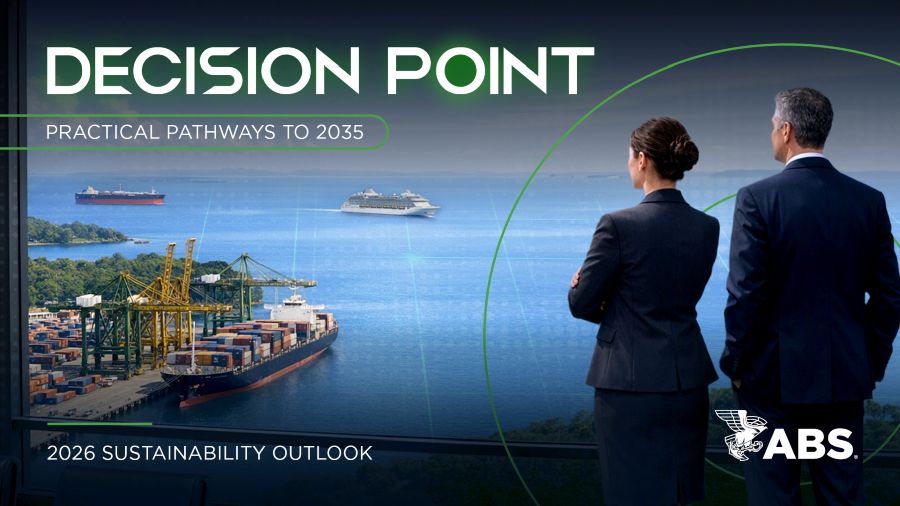
Shipping's challenge is now how organizations can navigate decarbonization while maintaining competitiveness, protecting asset value, and preserving access to capital, according to the 2026 ABS Outlook.
Titled Decision Point: Practical Pathways to 2035, the report examines the strategic, operational, and investment decisions facing shipowners as regulatory requirements evolve, carbon costs increase, and alternative fuels and technologies continue to develop.
“The industry has entered a new phase. For many years, the discussion centered on identifying a future fuel winner. Today, the challenge is broader. Shipping companies are making investment decisions for assets that will operate into the 2040s, while managing regulatory uncertainty, changing market expectations and evolving technology pathways. Success will depend on making practical decisions that create value under a range of future scenarios,” said John McDonald, ABS Chairman and CEO.
The report concludes that there is no single pathway for the industry. Instead, the optimal strategy depends on how vessels trade, their operational profile, regional exposure, fuel availability and commercial requirements.
Among the report's key findings:
- Trade pattern matters more than ship type. Fuel and investment strategies should be driven by operating realities and trading patterns rather than vessel type alone.
- Regulatory fragmentation is becoming a defining feature of the market. Shipowners increasingly face overlapping regional and international requirements that influence investment and operational decisions.
- Carbon costs are becoming a material operating expense. As carbon pricing frameworks mature, fuel efficiency and emissions performance are becoming increasingly important drivers of profitability and asset value.
- Energy efficiency remains the most immediate opportunity. Proven technologies and operational measures can deliver measurable improvements while reducing exposure to carbon-related costs.
- Digitalization and AI are emerging as strategic enablers. Data-driven decision-making is increasingly supporting performance optimization, risk management, and capital planning.
- Execution capacity may become a limiting factor. Shipyard availability, workforce capability, engineering resources, and infrastructure readiness are expected to play a growing role in determining how quickly decarbonization strategies can be implemented.
The report also identifies six strategic questions that shipping leadership teams should be addressing today, including fleet investment priorities, carbon-cost exposure, fuel flexibility, digital readiness and organizational execution capability.
According to ABS, the organizations best positioned for success through 2035 will not necessarily be those that make the most aggressive fuel selections, but those that improve efficiency, preserve optionality, strengthen digital capabilities, and align investment decisions with the realities of how their vessels trade.
“The decade ahead will be defined less by prediction and more by execution,” said Rostom Merzouki, ABS Vice President, Global Sustainability. “The industry has no shortage of potential pathways. The challenge now is converting those pathways into commercially viable actions at scale.”
Robban Assafina is now on WhatsApp channel. Click Here