According to UNCTAD’s Global Trade Update, international trade expanded strongly during the first half of 2026, although growth became increasingly uneven across regions and sectors.
Global goods trade reached an estimated US$13.7 trillion in the first six months of the year, marking a 12.5 per cent increase compared with the same period in 2025. Services trade also continued to grow, rising by 10.5 per cent.
Combined, goods and services added roughly US$2 trillion to global trade, keeping the world on track for a record annual trade value.
Highlights
- Global goods trade totaled about US$13.7 trillion during the first half of 2026, representing a 12.5 per cent increase compared with the same period in 2025, supported in part by higher prices.
- Service trade grew at a slower pace, expanding by 10.5 per cent compared with the first half of 2025.
- East Asian economies recorded the strongest trade growth in Q1 2026, with both developed and developing economies in the region expanding at rates well above the global average.
- Trade in AI- and electric vehicle-related goods grew significantly during the first quarter, and these sectors are expected to continue driving trade expansion.
- Geopolitical uncertainty continued to drive the reconfiguration of global supply chains and trade relationships, leading to shifts in bilateral trade patterns and greater diversification of trading partners.
- Global trade growth is expected to remain positive but increasingly uneven, with gains in selected sectors and regions offset by rising geopolitical tensions, policy uncertainty and trade costs.
Global trade trends and nowcast
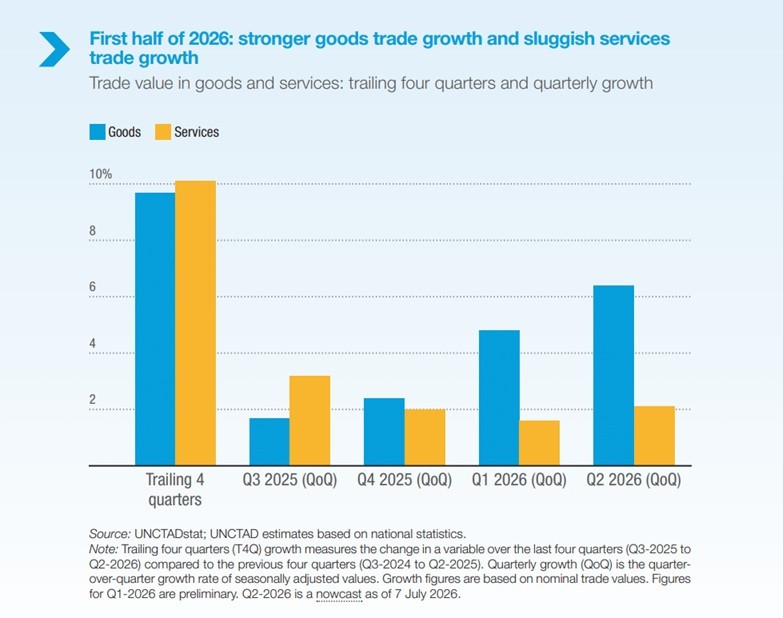
Global trade growth was strong in the first quarter of 2026, expanding by approximately 4 per cent quarter-on-quarter (QoQ), with goods trade increasing by 4.8 per cent and services by 1.6 per cent. UNCTAD’s nowcast suggests continued positive momentum into the second quarter of 2026, with preliminary estimates pointing to QoQ growth of 6.4 per cent for goods and 2.1 per cent for services.
Overall, global trade is estimated to have increased by about US$2 trillion in the first half of 2026 and is on course to reach a record annual value.
Part of this growth reflected higher trade prices rather than stronger trade volumes. The disruption to shipping through the Strait of Hormuz, together with heightened concerns over regional energy supplies, drove up global energy prices and increased transportation, logistics and production costs across international supply chains.
Global trade inflation rose sharply to 3.6 per cent QoQ in the first quarter of 2026, while UNCTAD’s nowcast suggests a further increase of around 5.1 per cent QoQ in the second quarter. Over the past 12 months, trade inflation has averaged about 3.4 per cent, indicating particularly persistent price pressure on global trade.
In the first quarter of 2026, global trade expanded by about 4 per cent quarter-on-quarter, with goods rising by 4.8 per cent and services by 1.6 per cent. UNCTAD’s nowcast points to further growth in the second quarter, particularly for goods.
However, a substantial share of the increase reflects higher prices rather than stronger volumes: trade inflation accelerated in the first half of the year as energy, transport, logistics and production costs rose.
Furthermore, performance remained highly uneven across economies and sectors. East Asia was the main engine of growth, with China and the Republic of Korea recording particularly strong goods trade, while the rest of Asia experienced slower growth.
Africa and the Americas registered import growth above the global average but comparatively weaker export performance.
At the sectoral level, demand for semiconductors, ICT products, electrical machinery, batteries, critical minerals and electric vehicles supported expansion, whereas chemicals, iron and steel, and some renewable-energy products contracted.
Robban Assafina is now on WhatsApp channel. Click Here