
Global trade surged by $2.5 trillion in 2025, marking a 7.5% increase and reaching a record $35 trillion, according to UNCTAD’s global trade update.
Momentum remained strong toward the end of the year, with trade rising by roughly 2% quarter-over-quarter (QoQ) in Q4 2025. While trade growth remained solid in the first quarter of 2026, global trade is expected to slow for the remainder of the year.
The conflict in the Middle East and the shipping disruptions in the Strait of Hormuz are likely to exacerbate inflationary pressures weighing on a global economy already challenged by geopolitical tensions, policy shifts, and limited fiscal space in many countries.
Highlights:
- Trade gains in 2025 were broad-based, with East Asia and Africa posting the strongest advances. South–South trade also outperformed overall global trends.
- Amid United States–China trade decoupling, several connector countries have emerged, stabilizing flows and supporting global trade growth despite rising geopolitical fragmentation.
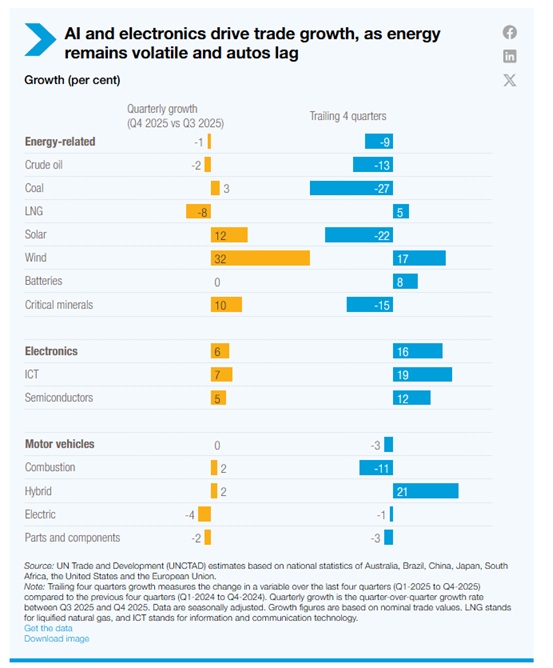
- A strong manufacturing sector, led by electronics trade, drove global trade growth, while the automotive sector remained subdued amid rising protectionism.
- Trade growth is expected to slow considerably in 2026, weighed down by geopolitical uncertainties, persistent inflationary pressures and rising trade costs, with only a few sectors expected to see trade expansion.
As explained, trade growth was driven primarily by goods, which expanded by about 7% and contributed roughly $1.8 trillion to global growth. Services also recorded strong performance, growing by around 8% and adding approximately $700 billion to the total increase.
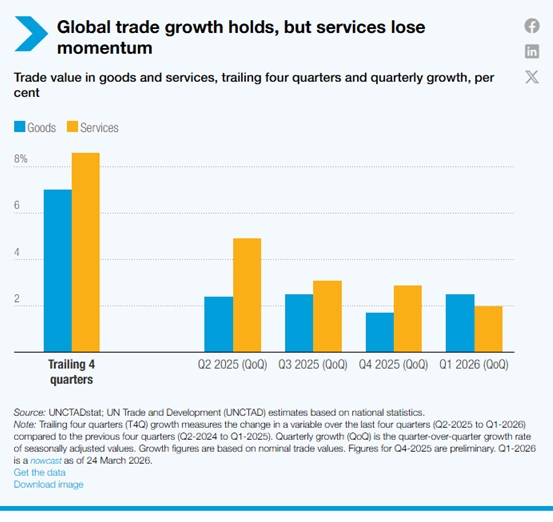
Overall, trade growth was widespread, but particularly strong among developing economies in East Asia and Africa. Notably, South-South trade outpaced the global average, expanding by about 9% and highlighting the increasing influence of developing economies in global trade.
AI and green industries support growth amid volatility
On the upside, strong global demand for AI-related goods, digital technologies and some green-industry products should remain strong and could help sustain trade’s overall performance.
This trend is already visible. The surge in AI- and ICT-related trade drove much of the manufacturing sector’s expansion in 2025 and is expected to remain an engine of growth in the coming quarters.
By contrast, energy trade remained volatile, and the automotive sector stayed subdued amid rising protectionism.
US-China trade slump reshapes global flows
A persistent feature of recent trade dynamics is the sharp contraction in trade between the United States and China, which fell by roughly one quarter in 2025, or about $170 billion.
Yet global trade has adapted. Several “connector economies” have emerged, acting as intermediaries. Serving often as logistical hubs or assembly points, economies such as Cambodia, Egypt, Viet Nam and Indonesia are helping to stabilize trade flows, support global growth and cushion the impact of increasing geopolitical fragmentation.
Robban Assafina is now on WhatsApp channel. Click Here