RightShip has introduced Revision 4.0 of its Dry Bulk Vessel Vetting Baseline Criteria, effective 1 October 2026, marking a significant update to the framework used to assess dry bulk and general cargo vessels and support vetting recommendations.
This is more than a periodic update of individual thresholds. RightShip’s own Revision Log states that Version 4 has been extensively reformatted and rewritten, with the stated objective of providing clearer baseline criteria, review thresholds, acceptability expectations and closure requirements.
Among the most important developments are a comprehensive revision of the Port State Control criteria, restructuring of incident assessment, expansion of Flag, Class and regulatory compliance requirements, stronger provisions on ownership transparency and sanctions, enhanced technical and operational requirements, and changes to RightShip Inspection and Management of Change requirements.
The scope has also been expressly expanded to include general cargo vessels alongside dry bulk vessels.
Importantly, the criteria remain RightShip’s recommended minimum baseline rather than an identical rulebook for every vetting customer. According to the Purpose section of Version 4, the criteria can be customised according to the specific needs and risk profiles of individual vetting customers.
Against this background, SAFETY4SEA reviewed the new criteria and their Revision Log to identify what has changed and, more importantly, what those changes mean in practice for ship operators.
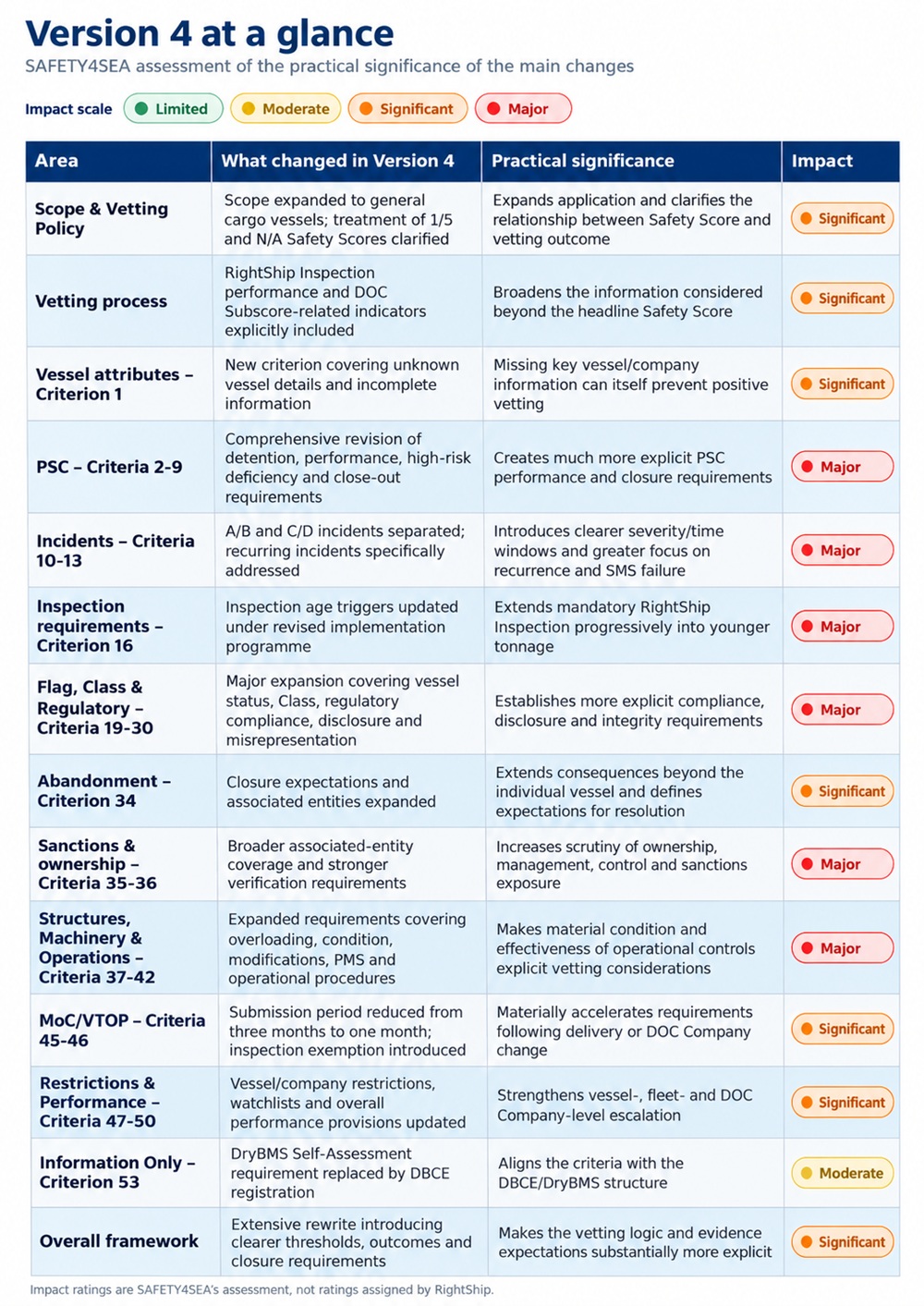
Version 4 at a glance
The following assessment uses four levels of practical significance: Limited, Moderate, Significant and Major. The significance ratings are SAFETY4SEA’s assessment of the operational impact of each change and are not ratings assigned by RightShip.
Safety Score and vetting: Version 4 makes the distinction clearer
An important clarification appears before the individual criteria begin. RightShip states in Version 4 that there is no minimum RightShip Safety Score for vetting. A vessel with a Safety Score between 1/5 and 5/5 may still be positively recommended, provided that the agreed vetting customer requirements are met. That does not mean that Safety Score is irrelevant.
The Vetting Policy states that vessels with lower Safety Scores may require additional vetting checks, potentially including a RightShip Inspection. Vessels with a 0/5 or 1/5 Safety Score are described as unlikely to receive a positive recommendation until the reason for the score has been investigated and resolved. Vessels with an N/A Safety Score may require additional information and checks.
The distinction is therefore important: Safety Score is an input into the vetting process; it is not, by itself, the vetting decision.
"Version 4 also expands the description of information considered during vetting. This includes PSC performance, incidents, RightShip Inspection performance, DOC Company and Technical Manager performance, Class status, abandonment cases, restrictions and previous vetting history."
1. Port State Control: one of the largest changes in Version 4
The treatment of Port State Control performance under Criteria 2–9 is one of the most substantial revisions. RightShip itself describes this section in the Revision Log as having been “comprehensively revised”, with enhanced requirements covering detentions, performance, high-risk deficiencies and close-out assessment. The result is a considerably more explicit PSC hierarchy.
Three or more PSC detentions: Unacceptable
Under Criterion 2, a vessel with three or more PSC detentions during the previous 24 months is Unacceptable.
Returning to an acceptable position requires RightShip to be satisfied that each detention has been reviewed and closed out, the root causes have been addressed and corrective and preventive measures are effective. A RightShip Inspection will normally also be required before a positive recommendation can be considered. This establishes a clear upper detention threshold, but the more significant change becomes apparent in the criteria immediately below it.
Two PSC detentions: review of severity, trend and close-out
Under Criterion 3, two PSC detentions during the previous 24 months make the vessel subject to review and potentially Unacceptable. The assessment is not based solely on the number of detentions. Version 4 expressly identifies: detention severity, deficiency profile, trend and close-out quality as relevant considerations.
Again, the vessel will not be positively recommended until the detentions have been reviewed and closed to RightShip’s satisfaction, root causes addressed and corrective and preventive measures considered effective. A RightShip Inspection will normally be required.
One detention can also trigger additional scrutiny
Under Criterion 4, one PSC detention during the previous 12 months triggers review. The detention must be satisfactorily reviewed and closed, including root cause and corrective/preventive measures. A RightShip Inspection may additionally be required depending upon the severity of the detention, deficiency profile, quality of close-out and the wider performance of the vessel or DOC Company.
The important development across Criteria 2–4 is therefore not simply the detention count.
"Version 4 makes considerably more explicit that RightShip will assess what happened, how serious it was, whether there is a trend and how effectively the company responded."
Poor PSC performance matters even without detention
Version 4 does not restrict PSC assessment to detentions. Under Criterion 5, a vessel with a PSC inspection performance history considered “less than adequate” becomes subject to review and may be Unacceptable. RightShip identifies deficiency severity, port deficiency averaging, trend and close-out quality as factors in the assessment.
The vessel will not be positively recommended until RightShip is satisfied that its PSC performance has been reviewed, root causes addressed and corrective and preventive measures are effective. A RightShip Inspection may also be required. This is a significant development because the vetting assessment therefore extends beyond the binary question of whether a vessel has been detained.
A pattern of deficiencies can itself become material.
No recent PSC inspection can itself require additional assurance
Criterion 6 deals with the opposite situation: a vessel with no PSC inspection records during the previous 24 months.
Such a vessel becomes subject to review and will not be positively recommended unless satisfactory recent independent assurance is available. Version 4 states that an acceptable valid RightShip Inspection completed within the previous 24 months is normally required.
In its absence, RightShip may consider other recent independent assurance, including a Flag State inspection with no adverse reports or a report from a recognised regulatory or industry assurance programme indicating no adverse findings. Where none is available, a RightShip Inspection may be required.
"The implication is clear: absence of an adverse PSC record is not automatically treated as evidence of satisfactory performance.
High-risk PSC deficiencies receive separate treatment"
Criterion 7 introduces explicit treatment of PSC deficiencies during the previous 24 months that present a high-risk condition or indicate unresolved structural, machinery, operational or safety-critical deficiencies. The outcome is Unacceptable until RightShip is satisfied that the deficiencies have been corrected.
Version 4 nevertheless allows consideration, in exceptional circumstances, of Class-approved temporary repairs or other risk-control measures where these are supported by documented conditions, restrictions, monitoring requirements and a defined plan for permanent repair.
A RightShip Inspection may also be required. This creates a clear distinction between an ordinary deficiency record and deficiencies indicating a potentially continuing high-risk condition.
PSC detention breaches extend beyond the vessel
Criterion 8 applies where a vessel, DOC Company, owner, operator, manager or other associated entity has evaded, ignored or departed in breach of a PSC detention or Port State Control order.
The outcome is Unacceptable. The inclusion of associated entities is important because the provision no longer treats such conduct exclusively as a vessel-specific event.
PSC close-out quality becomes a central consideration
Finally, Criterion 9 addresses vessels submitted for vetting with PSC deficiencies during the previous 12 months that have not been reviewed. Version 4 describes the expected PSC close-out submission as typically including: deficiency details, explanation, root cause analysis, corrective actions, preventive measures and supporting evidence.
For operators, the practical consequence is important. Closing a PSC deficiency administratively is not necessarily the end of the matter. The quality of the investigation and close-out can itself influence vetting.
2. Incident criteria are restructured around severity, time and recurrence
Version 4 substantially restructures incident assessment under Criteria 10–13. The framework now distinguishes between Category A/B incidents, Category C/D incidents and recurring incidents.
Under Criterion 10, a vessel involved in two or more Category A incidents within 24 months is Unacceptable unless clear and proven non-fault can be established. The incidents must be reviewed and closed out, including acceptable investigation, root cause analysis and corrective/preventive actions. A RightShip Inspection will normally be required before a positive recommendation can be considered.
Under Criterion 11, a single Category A or B incident during the previous 24 months triggers review. A post-incident RightShip Inspection will normally be required depending on severity, fault, close-out quality and related performance concerns. For Category C or D incidents, Criterion 12 establishes a 12-month review period.
However, perhaps the more significant addition is Criterion 13. It addresses recurring incidents during the previous 24 months that indicate a common root cause or repeated failure of the Safety Management System, regardless of incident category. The vessel may become Unacceptable depending on the incident pattern, severity and close-out quality, while a RightShip Inspection may also be required. This places greater emphasis on whether incidents represent isolated events or evidence of a systemic or recurring management failure.
3. RightShip Inspection requirements continue to move towards younger vessels
Criterion 16 incorporates RightShip’s revised inspection implementation programme. Version 4 states that the RightShip Inspection age triggers are:
- 11 years and above from 1 July 2026; and
- 10.5 years and above from 20 January 2027.
However, age is not the only trigger. Criterion 16 expressly states that performance concerns can relate to specific vessels, entire fleets or specific vessel groups, and can result from incidents, PSC inspections, previous RightShip Inspections or other safety, environmental, reliability or crew-welfare indicators.
A vessel without a valid RightShip Inspection where an inspection is required due to age or performance concerns is Unacceptable until an acceptable inspection has been completed or RightShip is otherwise satisfied that the requirement no longer applies.
Version 4 also maintains additional scrutiny around previous inspection performance. Under Criterion 17, a vessel whose most recent RightShip Inspection was assessed as Unacceptable remains Unacceptable until the findings have been satisfactorily addressed, with another inspection normally required.
Under Criterion 18, an inspection resulting in validity of three months or less triggers review and may also result in an Unacceptable outcome.
"Operators should therefore not interpret the published age threshold as the only circumstance in which a RightShip Inspection can become necessary."
4. Flag, Class and regulatory compliance is substantially expanded
One of the broadest Version 4 revisions concerns Criteria 19–30. RightShip’s Revision Log expressly describes this section as expanded to include enhanced requirements relating to: vessel status, classification, regulatory compliance, disclosure obligations and misrepresentation. The section therefore extends considerably beyond conventional Flag and Class performance.
Flag performance
Criteria 19–21 establish different treatments for vessels associated with Paris or Tokyo MoU risk categories. A Very High Risk blacklisted Flag under Criterion 19 results in an Unacceptable outcome.
Criterion 20 addresses the combination of a blacklisted Flag with a Low or Very Low performing Class Society and also results in an Unacceptable outcome.
Under Criterion 21, vessels with a Targeted, Medium-to-High or High Risk Flag require a valid RightShip Inspection for acceptance.
Class and statutory conditions become more explicit
Under Criterion 22, overdue Class or statutory conditions, certificates, surveys or other mandatory requirements result in an Unacceptable outcome. The vessel remains Unacceptable until the overdue matter has been remedied or accepted by the relevant Class Society, Flag State or issuing authority and RightShip is satisfied that the reason for the overdue status has been resolved.
Criterion 23 separately addresses current, in-date Class or statutory conditions, memoranda, recommendations or survey findings that may affect safe operation, statutory compliance, trading ability or vessel readiness.
These are subject to review and may also result in an Unacceptable outcome depending on their operational or compliance impact.
Vessel operational status enters the assessment
Criterion 24 addresses vessels whose classification status is other than In-Service or whose operational status is other than In Trading Fleet. Examples identified in the criterion include vessels laid up, in casualty, under repair, in dry dock, detained, arrested, withdrawn from service or otherwise unavailable for normal commercial operation.
Such vessels are subject to enhanced review and may be Unacceptable depending on the circumstances and operational impact.
De-classing and Class suspension can have wider company consequences
Criterion 25 deals with vessels de-classed, suspended, withdrawn or otherwise invalidated during the previous 24 months. The provision can encompass failure to maintain classification standards, unresolved survey issues and other circumstances affecting Class status. Where the Class issue is associated with a DOC Company, owner, operator, manager or related entity, Version 4 expressly allows wider fleet- or company-level review. That extension beyond the individual vessel is an important recurring feature of the new edition.
5. Disclosure to Flag and Class becomes an explicit vetting issue
One of the more important additions appears in Criterion 26. A vessel, DOC Company, owner, operator, manager or associated entity found to have failed to notify Flag State and/or Class of matters requiring notification becomes Unacceptable.
The criterion specifically refers to matters including: incidents, damage, defects, unauthorised repairs, structural issues, machinery failures and other conditions affecting compliance, seaworthiness or safe operation.
Resolution can require supporting evidence from Flag or Class, updated certificates or survey status, completion of required surveys or approvals, a RightShip Inspection and/or a DOC Company Management Assessment/Audit.
Again, where the non-notification is associated with the company or another related entity, RightShip may undertake wider fleet- or company-level review. This makes disclosure itself part of the vetting assessment, rather than considering only the underlying technical condition.
6. Misrepresentation and information integrity receive explicit treatment
Version 4 continues this approach through Criteria 27–30.
Criterion 27 makes fraudulent Flag representation Unacceptable.
Criterion 28 addresses vessels for which valid Class or Flag status cannot be verified, or vessels operating without valid Class or Flag registration.
Criterion 29 addresses deliberate contravention of international standards, conventions, laws or mandatory regulatory requirements. The criterion specifically references IMO, SOLAS, MARPOL, STCW, MLC, Class, Flag State, Coastal State and Port State requirements.
But Criterion 30 is particularly noteworthy. It applies where a vessel, DOC Company, owner, operator, manager or other associated entity deliberately provides RightShip with false, misleading, incomplete or materially inaccurate information, or deliberately withholds information considered critical to the vetting assessment.
RightShip specifically identifies non-disclosure of: incidents, PSC outcomes, Class or statutory issues, management changes, ownership/control details, sanctions exposure and other adverse information.
The outcome is Unacceptable until the matter has been investigated, the information record corrected and appropriate corrective and preventive measures implemented. RightShip may additionally require supporting evidence, a RightShip Inspection and/or a DOC Company Management Assessment/Audit.
Version 4 therefore makes information integrity an explicit element of vetting.
7. Human rights and abandonment requirements are strengthened
The Human Rights section covers MLC compliance, human-rights abuses, living and working standards and abandonment of seafarers under Criteria 31–34.
The specific Version 4 change identified by RightShip concerns Criterion 34, dealing with abandonment. A vessel subject to a current ILO Abandonment of Seafarers case is Unacceptable. Importantly, this now also extends to a vessel associated with an owning, managing or operating entity that is subject to a current abandonment case.
For closure, RightShip expects the abandonment case to have been resolved, affected seafarers to have been repatriated and/or compensated as applicable and appropriate corrective and preventive measures to have been implemented.
Where required, the vessel must also successfully complete a RightShip Inspection. Repeat or multiple abandonment cases involving a common vessel, DOC Company, owner, operator or managing entity may result in continued Unacceptable status or wider company-level review.
"Once again, the significance lies partly in the widening of the assessment from individual vessel to associated company/entity."
8. Sanctions and ownership transparency receive stronger treatment
Version 4 strengthens Criteria 35–36, covering sanctions and ownership transparency.
Under Criterion 35, the entities potentially captured now expressly include: vessel, Flag, Registered Owner, Beneficial Owner, DOC Company, Technical Manager, Commercial Operator, Commercial Manager and other associated entities.
The criterion references sanctions, restrictions and prohibitions imposed by recognised authorities and regimes, including OFAC, USCG, AMSA, DFAT, EU, UK, UN and Port State Control authorities/MoUs.
Where an applicable sanction or restriction exists, the outcome is Unacceptable until RightShip is satisfied that it no longer applies or that the vessel and relevant associated entities fall outside its scope.
Criterion 36 deals separately with the ability to verify management, control, ownership, commercial operation and associated-entity information. Incomplete Registered Owner or Beneficial Ownership information does not necessarily produce automatic rejection where no wider concerns exist.
However, inability to verify relevant control, management or associated-entity information – or identification of sanctions exposure, restricted-party involvement, deliberate non-disclosure, misrepresentation or other material integrity concerns – can result in an Unacceptable outcome.
"The vetting perimeter therefore extends beyond the vessel and immediate DOC Company into the broader ownership and control structure."
9. Technical condition and operational effectiveness receive stronger scrutiny
RightShip’s Revision Log identifies Criteria 37–41 as having been enhanced through expanded guidance covering overloads, vessel condition, modifications, maintenance systems and operational procedures. The detailed criteria show why this matters.
Structural reassessment
Criterion 37 covers Class reassessment of scantlings undertaken in an attempt to avoid steel renewals following excessive wastage. Such cases are subject to review, and RightShip may require a Hull Structure CAP with the applicable acceptable CAP rating.
Overloading
Under Criterion 38, a vessel known or credibly reported to have been overloaded, loaded beyond approved limits or operated outside applicable loading, stability, structural, draught or load-line requirements can be Unacceptable where the necessary subsequent structural assessment, Class review and repairs or approvals have not been satisfactorily completed.
RightShip may require Class/Flag evidence, loading records, stability documentation, root cause analysis, corrective/preventive measures and/or a RightShip Inspection or Hull Structure CAP.
Poor material condition
Criterion 39 addresses vessels found, reported or credibly suspected to be in poor material condition or to have poor maintenance standards affecting structural, machinery, cargo, safety-critical or operational systems. The outcome is Unacceptable.
Supporting evidence and a satisfactory RightShip Inspection will normally be required before a positive recommendation can be considered.
Modifications, conversions and repairs
Under Criterion 40, substantial recent alterations, modifications, conversions or extensive repairs become subject to review where they could affect vessel structure, machinery, cargo systems, operational capability, certification or trading readiness.
Having a PMS is not enough if it is not effective
Criterion 41 is particularly relevant from an operational-management perspective. A vessel found, reported or credibly suspected to have no effective Planned Maintenance System, or where the PMS is not actually being used to control safety-critical, statutory, machinery, structural, cargo or operational maintenance, is Unacceptable.
RightShip expects an effective system to be implemented and used to manage maintenance, defects, overdue tasks and safety-critical equipment. The distinction is important: the requirement concerns effective implementation, not simply the existence of a documented PMS.
A similar principle appears in Criterion 42, covering key shipboard operational procedures and instructions. Where effective procedures do not exist – or exist but are not actually implemented for safety-critical, statutory, cargo, machinery or navigational operations – the vessel is Unacceptable.
Supporting evidence and a satisfactory RightShip Inspection will normally be required. The emphasis therefore moves beyond documented systems towards demonstrated operational effectiveness.
10. Management of Change timeframe falls from three months to one
A relatively simple but operationally important change concerns Criteria 45–46. For both: newbuild delivery; and change of DOC Company, the period for completing and submitting the RightShip Management of Change/Vessel Take Over Process MoC/VTOP Questionnaire has been reduced from three months to one month. Version 4 nevertheless broadens the exemption routes.
The requirement may not apply where the DOC Company holds the specified RightShip DryBMS Verification Assessment at Advanced Level for the relevant subject area or where the vessel has completed an acceptable RightShip Inspection. For a DOC Company change, that inspection must have been completed under the new DOC Company.
"The practical effect is therefore: a considerably shorter compliance window, accompanied by an additional inspection-based route to exemption."
11. Poor company performance can produce fleet-wide consequences
The revised framework also provides greater clarity around restrictions and cumulative performance under Criteria 47–50.
Under Criterion 47, a vessel or company appearing on a RightShip or customer Restricted List becomes subject to the applicable restriction.
Criterion 48 deals with cumulative performance where a vessel fails non-binary baseline criteria and overall performance is considered well below acceptable. RightShip states that both the number and severity of contributing factors – and the calibre of the DOC Company’s investigation and corrective/preventive measures – will be assessed.
This can result in the vessel being considered Not Acceptable or being required to undergo a satisfactory RightShip Inspection. The consequences can extend further at company level.
Under Criterion 49, a DOC Company considered generally poor in terms of overall operational and safety performance can become subject to additional measures including: mandatory RightShip Inspections across its fleet, technical holds across managed vessels, placement on a RightShip Company watchlist and a Management Assessment/Audit.
Criterion 50 provides comparable measures for individual vessels with generally poor operational and safety performance. This reinforces one of the recurring developments in Version 4: individual vessel performance can lead to broader DOC Company or fleet-level consequences.
12. DBCE registration replaces the previous DryBMS Information Only criterion
Version 4 retains three Information Only Criteria. RightShip makes clear that these do not currently form part of its recommended Vetting Baseline and therefore have no present impact on the standard vetting outcome, although individual customers may incorporate them into bespoke requirements. They cover:
- Criterion 51 – Crew Welfare Self Assessment
- Criterion 52 – EEDI, EEXI or CII and Energy Saving Measures
- Criterion 53 – DBCE registration
The Version 4 change concerns Criterion 53. The previous DryBMS Self-Assessment requirement has been replaced by whether the DOC Company has registered with the Dry Bulk Centre of Excellence (DBCE).
RightShip encourages DOC Companies to register as DBCE members and complete a DryBMS Self-Assessment through the DBCE DryBMS online portal.
For now, however, this remains an Information Only criterion rather than a baseline acceptance requirement.
What should operators take from Version 4?
Taken together, the Version 4 changes point to several practical conclusions.
a) PSC performance is receiving considerably greater granularity.
Detention count remains important, but it is only part of the assessment. Version 4 expressly brings deficiency severity, port averaging, trends, high-risk conditions and close-out quality into the decision process. Operators therefore need to look beyond whether a PSC deficiency has technically been closed. The quality of the investigation, root cause analysis, corrective action, preventive measures and supporting evidence can all matter to subsequent vetting.
b) Recurrence matters more explicitly.
This is visible both in incident assessment and wider vessel performance. A series of individually manageable events may create a different vetting outcome where the pattern suggests a common root cause or repeated failure of the Safety Management System.
c) Disclosure and information integrity have become much more explicit vetting considerations.
Failure to notify Flag or Class, fraudulent representation, deliberate regulatory contraventions and deliberate withholding or misrepresentation of information to RightShip now have clearly defined consequences.
d) The vetting perimeter is becoming wider than the individual ship.
Several criteria expressly refer to DOC Companies, owners, managers, operators, beneficial owners, commercial interests and other associated entities. In a number of circumstances, a vessel-level problem can lead to fleet- or company-level review, mandatory inspections, technical holds, watchlisting or management assessment.
e) Greater emphasis on demonstrating effective resolution
Across PSC, incidents, Class and statutory matters, technical deficiencies and company performance, the same sequence appears repeatedly: investigation, root cause, corrective action, preventive action, supporting evidence, verification where required. For operators, this is perhaps the most practical message from the new edition.
Version 4 does not simply ask whether an adverse event occurred. Increasingly, it asks what happened, why it happened, whether it is part of a wider pattern, what the company did about it and whether the response can be demonstrated to have been effective.
In this respect, the new edition represents a material tightening and clarification of RightShip’s vetting baseline, particularly around PSC performance, incident recurrence, regulatory integrity, technical condition, disclosure and company-level accountability.
Source: Safety4Sea
Robban Assafina is now on WhatsApp channel. Click Here