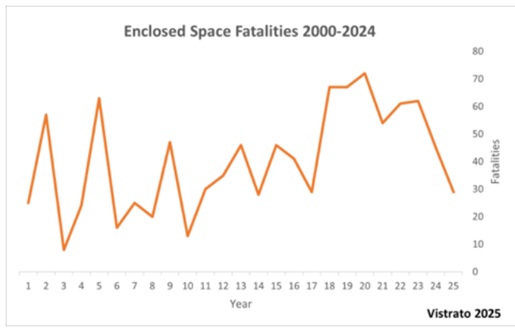
Between 2000 and 2024, at least 1,010 ship and shore workers lost their lives in enclosed spaces aboard vessels covered by the SOLAS Convention.
In response to concerns over the ongoing loss of life in the cargo holds of ships loading or discharging solid bulk cargoes at ports and terminals worldwide, Vistrato undertook a review of all reported accidents to identify underlying trends and consolidated the data on the “True Scale of Enclosed Space Fatalities aboard Ships” report.
Initially, the International Bulk Terminals Association (IBTA) submitted data to IMO on ship and shore worker fatalities in cargo holds during solid bulk cargo handling and later expanded the analysis to assess the full scale of cargo-related and non-cargo-related fatalities in enclosed spaces across all ship types.
Total enclosed space fatalities for the period 2000 to 2024
At least 1,010 ship and shore workers lost their lives in enclosed spaces between 2000 and 2024 on ships covered by the SOLAS Convention. The average loss of life is 40 fatalities per year for the 25-year period. 12 The worst year on record was 2019 with 72 fatalities.
The total loss of life for the last 5 years from 2020 to 2024 is 250, averaging 50 deaths per year, but is now showing a significant downward trend, with at least 29 fatalities reported to date for 2024.
Fatalities by ship type
In summary, tankers accounted for the highest number of enclosed space fatalities, with a total of 402 deaths, followed by 308 on bulk carriers and 134 on general cargo ships. Containerships and offshore vessels each recorded 53 fatalities, while Ro-Ro and reefer ships had 15 deaths each.
Dredgers accounted for 11 deaths, passenger ships 10, and other vessel types, including car carriers, livestock carriers, and commercial yachts, totaled 9 fatalities.
Smaller ships appear to be more frequently involved in these incidents than larger vessels, largely due to the leakage of cargo gases from cargo spaces into adjacent accommodation, forecastle working areas, electrical switch rooms, ballast tanks, and void spaces.
Causes of fatalities
Analysis of enclosed space fatalities shows that 466 (46%) of all deaths were caused by asphyxiation due to oxygen depletion and/or toxic gas poisoning, 364 (36%) resulted from explosions and/or fires, and 180 (18%) were due to physical hazards, with over half of these linked to falls.
Furthermore, on tankers, explosions and fires from flammable atmospheres were the leading cause of the 402 enclosed space fatalities (64%), followed by asphyxiation/toxic gas (31%) and physical hazards (5%). For bulk carriers, asphyxiation/toxic gas accounted for the majority of the 308 deaths (65%), followed by physical hazards (24%) and explosion/fire (11%).
Across all other ship types, asphyxiation/toxic gas was also the primary cause (48%), with physical hazards responsible for 28% and explosions/fires for 24% of the 300 fatalities.