Oman has submitted a proposal to the IMO’s Marine Environment Protection Committee at its 84th session (MEPC 84, April 27 – 1 May), seeking the designation of a Particularly Sensitive Sea Area (PSSA) along its Arabian Sea coast.
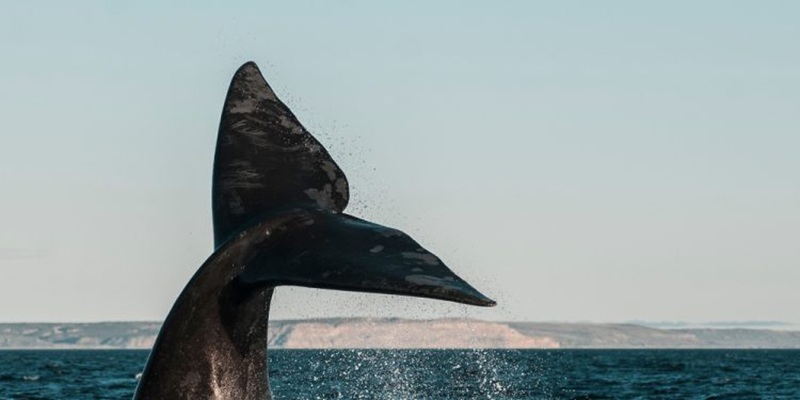
The proposed area is known for its exceptional marine productivity, driven by a major coastal upwelling system, and supports a wide range of species and fisheries. Particular concern has been raised over the endangered Arabian Sea humpback whale, a unique, non-migratory population of fewer than 100 individuals.
A Particularly Sensitive Sea Area (PSSA) is an area that has been provided special protection through action by the IMO because of its significance for recognized ecological, socio-economic, or scientific attributes, and which may be vulnerable to damage by international maritime activities.
Studies cited in the submission indicate that ship strikes are already affecting the population, with even one or two additional deaths per year posing a serious threat to its survival.
To tackle this, Oman has outlined a series of potential protective measures, including rerouting vessels further offshore, introducing speed reductions of around 10 knots in high-risk areas, and establishing designated zones such as areas to be avoided and recommended transit routes. Early modelling suggests that shifting shipping lanes approximately 40 nautical miles offshore could significantly reduce the likelihood of vessel strikes.
Oman’s proposal
To ensure associated protective measures (APMs) are proportionate, Oman is currently conducting a revised study for the proposed PSSA including a) baseline evaluation of AIS data to characterize current shipping traffic and risks to whales, and b) a Cost-Benefit Analysis (CBA) for selected mitigation scenarios. The CBA study evaluates the trade-offs between biological risk reduction and impacts to shipping, including increased transit time and fuel consumption.
The CBA study evaluates the trade-offs between biological risk reduction and impacts to shipping, including increased transit time and fuel consumption.
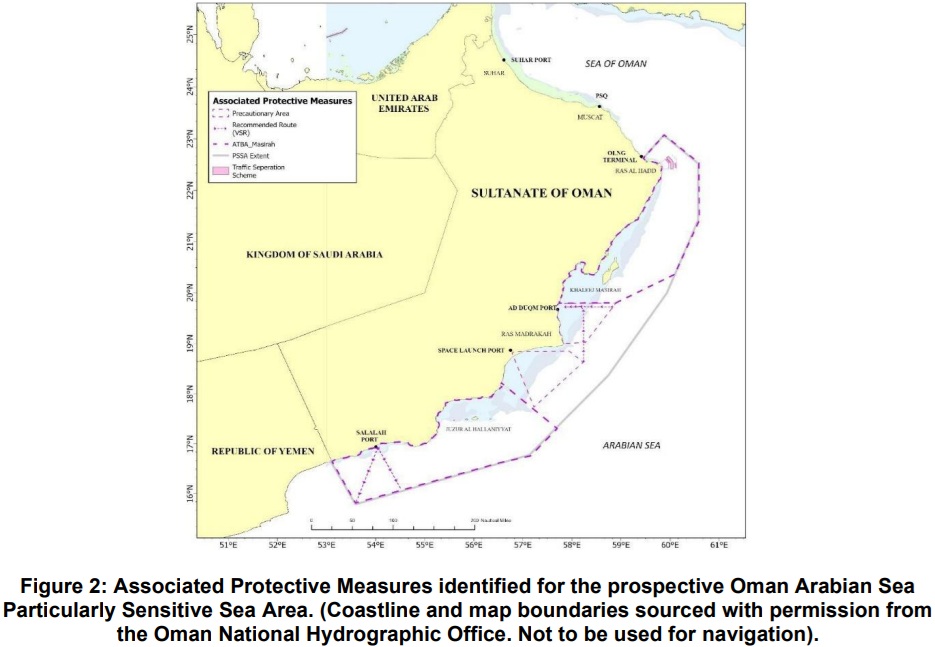
Prospective Associated Protective Measures
- Areas to be avoided (ATBA): Two ATBAs are proposed—one extending offshore from Juzur Al Hallaniyyat (Hallaniyyat Bay) and another around the Khaleej Masirah (Gulf of Masirah) and Masirah Island to divert transit traffic away from core humpback whale habitats;
- Precautionary area: An area in the Gulf of Masirah encompassing recommended routes with a voluntary speed reduction (VSR) of 10 knots;
- Port access routes: Two recommended routes with 10-knot VSR measures for vessels transiting to and from Salalah Port;
- Reporting and monitoring: A voluntary ship reporting scheme within the PSSA boundary and a 12-knot VSR for vessels navigating between the PSSA limit and the recommended routes; and
- Traffic separation scheme (TSS) adjustment: A proposal to move the Ras Al Hadd TSS further offshore, following the technical guidelines in MSC.1/Circ.1060.
Next steps
Oman will finalize the ship strike risk assessment and CBA to refine the APMs. Following review of this submission, a technical proposal will be submitted to the IMO’s Sub-Committee on Navigation, Communications and Search and Rescue detailing the ATBA and recommended routes.
Throughout 2026, Oman intends to conduct bilateral consultations and technical workshops with Member States to ensure the final APMs effectively balance environmental protection with the safety and efficiency of international shipping.
Member States and international organizations are invited to register their interest in reviewing the proposed routeing scenarios and technical assessments by the Government of Oman during 2026.
Source: Safety4sea
Robban Assafina is now on WhatsApp channel. Click Here