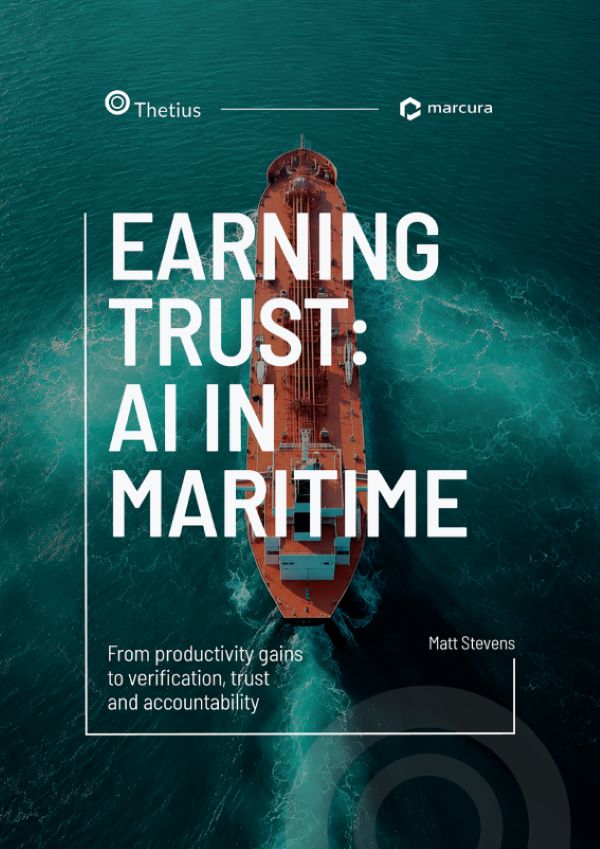
New Thetius and Marcura research finds AI is already embedded in maritime workflows, but organisations are still working out how to assess the full human-AI process, from verification and accountability to governance, and where human judgement adds most value.
Almost two-thirds (63%) of maritime professionals now use AI every day, according to new research from Thetius and Marcura. Yet only 8% describe their organisation as mature and governed in how it uses AI.
More than half (55%) spend at least an hour each week checking or correcting what AI produces, with almost one in five spending five hours or more. Even so, 85% say AI saves them time overall once that checking is taken into account.
The verification tax
The report calls the time and attention spent checking AI-generated work the “verification tax”. The question now is how much of that verification is necessary.
Trust remains qualified. When asked how much they trust AI-generated outputs, 57% placed themselves at the midpoint of a five-point scale. AI may have become part of everyday work, but confidence in its outputs is still catching up.
Some checking is unlikely to disappear, nor should it. Seven in ten say they would always check an AI recommendation before acting on an important business decision, while 80% believe a named person should always remain accountable for a commercial decision, however capable AI becomes.
Not all verification is necessary
But other checking is driven by uncertainty. Most respondents encounter errors at least sometimes when checking AI output, and fewer than one in ten say their organisation's data is fully ready for AI to rely on. If experience had shown an AI output to be reliable, 47% said they would spend much less time checking it.
The opportunity, the report argues, is not to eliminate human oversight, but to make it proportionate: keep it where the consequences of getting something wrong demand it, and reduce unnecessary checking as confidence grows.
Janani Yagnamurthy, Senior Vice President, Product, Strategic Growth at Marcura, said: “Maritime doesn't have a shortage of data. The problem is that the context needed to make a good decision is often scattered across contracts, emails, documents, systems and the experience of the people doing the work. Putting AI on top of that fragmentation doesn't make the problem disappear.
“The opportunity is to bring that context together at the point where a decision is being made, and then learn from what actually happens. When the system can show what it is basing an answer on, be tested against real outcomes and improve from human corrections, there is less reason to check everything from scratch. That is how AI starts to earn trust rather than simply asking for it.”
From recommendation to action
The stakes rise as AI moves from producing answers to taking action.
Almost three quarters (72%) say their organisations are already using, piloting or planning agentic AI systems capable of taking action rather than simply making recommendations. Yet only 15% say their governance is ready for agentic AI.
The gap raises a practical question: what can AI do independently, what still requires human review, and who remains accountable for the outcome?
A “collective brain”
The report notes that AI is also changing how experience is shared. Three quarters (75%) say it is helping less-experienced colleagues become effective faster.
One example is CP Optimiser, an AI-driven charter party review tool co-developed by Marcura and Tomini Chartering. It analyses charter parties against the company's accumulated knowledge, surfacing clauses and risks that might otherwise depend on an experienced colleague recognising them.
Thomas Stjernholm, Managing Director, Commercial, at Tomini Chartering, who describes the system as a “collective brain” for the organisation, said: “It's a human-to-AI-to-human process: the human puts in the knowledge, the AI curates and connects it to the clause in front of you, and the human makes the final decision.”
Earning Trust: AI in Maritime concludes that companies should measure the complete human-AI process, differentiate necessary verification from checking driven by uncertainty, use human corrections to improve future performance, and establish clear ownership and governance.
Robban Assafina is now on WhatsApp channel. Click Here