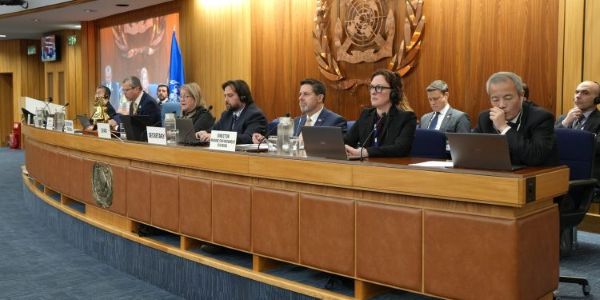
The International Maritime Organization’s Sub-Committee on Pollution Prevention and Response (PPR) met for its 13th session from 9–13 February 2026, making progress on various matters concerning MARPOL Annexes.
The Sub-Committee is responsible for all matters relating to marine pollution prevention and response within IMO’s remit, including MARPOL annexes, ballast water and biofouling management, anti-fouling systems, oil and hazardous substance pollution preparedness and response, and ship recycling. Lloyd’s Register (LR) has provided an overview of some of the significant outcomes from PPR 13:
MARPOL Annex I
- Finalization of draft amendments to MARPOL Annex I and consequential changes to the IOPPC and Oil Record Book, with respect to the forced evaporation of oily bilge water. These will be sent to MEPC for approval and subsequent adoption.
- Agreement to draft 2026 Guidelines for systems for handling oily wastes in machinery spaces of ships incorporating guidance notes for an integrated bilge water treatment system (IBTS).
- Agreement to draft revised Guidance for the recording of operations in the Oil Record Book Part I – machinery space operations (all ships), which will ultimately replace MEPC.1/Circ.736/Rev.2.
MARPOL Annex II & IBC Code
Agreed a draft revised PPR.1/Circ.10 Resubmission of products listed in lists 2 and 3 of the MEPC.2 Circular on provisional categorization of liquid substances in accordance with MARPOL ANNEX II and the IBC Code (with a view to endorsement by MEPC 84).
MARPOL Annex IV
Made further progress on the revision of MARPOL Annex IV and associated guidance with respect to improving sewage effluent discharge from ships.
MARPOL Annex VI & NOx Technical Code
- Agreed a package of amendments to the NOx Technical Code 2008 to provide a means for certification of engines that operate on non-carbon-containing fuel or mixtures of carbon-containing and non-carbon-containing fuels, which will be sent to MEPC 84 for approval.
- Approved draft amendments to MARPOL Annex VI Regulation 15 and the supplement to the IAPP certificate (Appendix I of MARPOL Annex VI), introducing a requirement for new tankers carrying crude oil to be fitted with p/v valves with a minimum opening pressure of 0.20 bar.
Agreed to the following new unified interpretations (subject to approval by MEPC 84 and eventual inclusion into a future revision of MEPC.1/Circ.795):
- Clarification of the application of regulation 16 (shipboard incineration).
- Clarification of the application of the “three-date” criteria for PSSA application dates, in relation to NOx Technical Code compliance after major conversion.
Development of a legally binding framework for the control and management of ships’ biofouling
- Established a correspondence group to further progress the overarching objectives and structure of the framework, as well as associated guidance and develop a work plan.
Follow-up work emanating from the Action Plan to Address Marine Plastic Litter from Ships
- Agreed the 2026 Strategy and the Action Plan to Address Marine Plastic Litter from Ships, for adoption by MEPC 84.
- Recommended to MEPC that a new mandatory code for the carriage of plastic pellets could be developed through MARPOL Annex III and/or SOLAS.
- Agreed a draft MEPC circular to promote the implementation of fishing gear marking systems and the FAO Voluntary Guidelines for the Marking of Fishing Gear, to be sent to MEPC 84 for approval
Two items from PPR’s post biennial agenda are proposed to be included in the provisional agenda for PPR 14, which is subject to approval by MEPC:
- Assessment of the implementation of the Hong Kong Convention through an experience-building phase and development of amendments and clarifications as appropriate. This has a target completion year of 2030.
- Development of guidelines for managing ammonia effluent generated from ammonia-fuelled ships. This has a target completion year of 2028.
To remind, a coalition of environmental and technology NGOs urged the International Maritime Organization (IMO) to reject proposals that would allow ships to routinely discharge ammonia into the ocean.