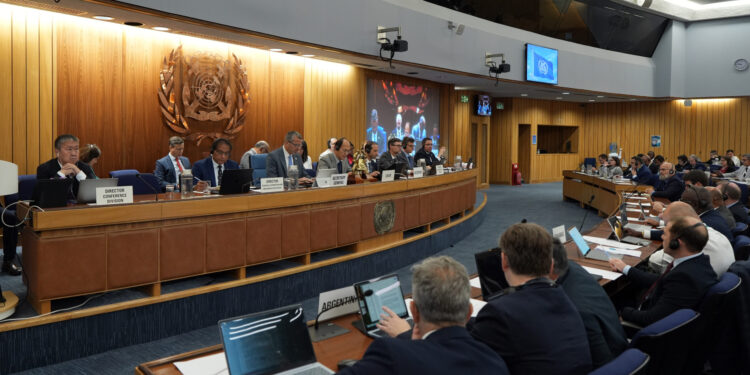
The 12th session of IMO’s Sub-Committee on Implementation of IMO Instruments (III 12) took place 20 – 24 July, progressing amendments to port State control procedures, survey guidelines and ship transfer provisions.
The Sub-Committee on Implementation of IMO Instruments (III) brings together flag, port and coastal States to consider implementation issues, including the analysis of consolidated audit summary reports from the mandatory IMO Member state Audit Scheme.
Following the conclusion on the Sub-Committee, Lloyd’s Register (LR) has provided the following overview of some of the significant outcomes from III 12:
Key outcomes
The draft amendments to the 2025 Procedures for Port State Control (A.1206(34)) were progressed, including new guidance for PSCOs on machinery and maintenance inspections and revised PSCO qualification requirements, with the 2027 edition of the PSC Procedures planned to enter into effect on 1 January 2028.
The draft amendments to the Survey Guidelines under the Harmonized System of Survey and Certification (HSSC) 2025 (A.1207(34)) were progressed, including updates to reflect new IMO requirements, upcoming pilot transfer arrangement provisions, and the introduction of a coding system for remote surveys, with the 2027 edition of the HSSC Procedures planned to enter into effect on 1 January 2028.
The draft amendments to MSC/Circ.1140 – MEPC/Circ.424 on Transfer of ships between States were finalized, introducing a notification mechanism for ships deregistered without a new flag State. These are expected to be approved by MSC 112 and MEPC 85 in late 2026.
1. Draft amendments to the “Procedures for Port State Control, 2025”
The Procedures for Port State Control, 2025 A.1206(34), while not mandatory, are widely implemented and referenced by regional Port State Control (PSC) regimes (e.g. Paris MoU, Tokyo MoU) and are regarded as the global benchmark for PSC inspections. The Procedures are typically revised every two years to reflect amendments to IMO instruments and evolving inspection practices.
The following proposals for the 2027 revision of the PSC Procedures were considered and progressed as follows:
A new appendix providing harmonized guidance for Port State Control Officers (PSCOs) on the inspection of ship machinery and maintenance systems.
It is recognized that machinery-space inspections and the assessment of maintenance arrangements can be technically challenging, and that the current PSC Procedures lack detailed guidance in this area. Dedicated guidance to support more consistent and effective inspections has been developed.
- Amendments to section 1.9 of the PSC Procedures concerning PSCO qualifications.
It was discussed that requiring a PSCO to be qualified as a flag State surveyor may unnecessarily be restrictive. However, it was emphasized that the issue was not whether PSCOs should be competent, as the need for competent PSCOs worldwide was undisputed, but rather the appropriate minimum entry requirements and training pathways for officers entering the PSC system.
- Draft appendix 21 covering list of instruments relevant to PSC Procedures.
The list includes but is not limited to MEPC.400(83) Amendments to the 2021 Guidelines on the operational carbon intensity reduction factors relative to reference lines (CII reduction factors guidelines, G3), A.1204(34) Code on Alerts and Indicators, 2025 etc.
However, due to time constraints, the work could not be completed during the session and will continue intersessionally, with finalization currently expected at III 13 (July 2027). Once finalized the revised PSC Procedures are expected to be implemented from 1 January 2028.
2. Survey Guidelines under the Harmonized System of Survey and Certification (HSSC)
a. Draft amendments to 2025 HSSC Survey Guidelines (A.1207(34))
The Survey Guidelines under the Harmonized System of Survey and Certification (HSSC) are regularly reviewed and updated to accommodate new regulatory requirements. While these guidelines are not made mandatory by the IMO, the guidelines are mandatory for all European Union Recognized Organizations (most IACS members) under EU Regulation 391/2009.
The development of the 2027 edition of the HSSC Survey Guidelines has been initiated with work expected on:
- Draft amendments arising from mandatory instruments that have entered into force, or are expected to enter into force, by 31 December 2027, including the Hong Kong Convention, together with any amendments adopted under the SOLAS four-year cycle with entry into force dates between 2028 and 2029;
- Draft amendments related to the new SOLAS regulation V/23 on Pilot Transfer Arrangements and the associated Performance Standards; and
- A Draft Coding System for Remote Surveys, to be incorporated into the HSSC Guidelines to indicate the remote survey eligibility of individual survey items.
The revision of the Survey Guidelines will continue intersessionally, and is expected to be finalized at III 13, and adopted at Assembly 35 (December 2027), with an anticipated implementation date of 1 January 2028.
b. Method for developing and assigning a coding system to update the Survey Guidelines under the HSSC
As part of its work on enabling remote surveys under the HSSC Survey Guidelines, there was broad agreement on the overall framework for identifying whether HSSC survey items are eligible for remote surveys, including:
- Adding a new “Remote survey eligible” column to the Survey Guidelines under the HSSC.
- Using a three-code system:
- Y = Eligible for remote survey.
- N = Not eligible.
- C = Conditionally eligible, subject to specified criteria.
Converting the existing Guidelines into a tabular format with standard headings:
- Code
- Survey Item
- Survey Requirements
- Eligibility for Remote Survey (Y/C/N)
Applying the coding based on normal operating circumstances, while recognizing that Administrations may authorize remote surveys on a case-by-case basis in exceptional situations.
However, due to the complexity of the task and time constraints, the coding system was not finalized. The work is expected to continue intersessionally, with finalization expected at III 13 (July 2027).
3. Amendments to MSC/Circ.1140 – MEPC/Circ.424 on Transfer of ships between States
Concerns were raised about ships that are deregistered by a flag state for non-compliance with statutory requirements before securing registration with a new flag State. To address this gap, draft amendments to MSC/Circ.1140 – MEPC/Circ.424 were developed which introduce a notification mechanism under which flag States would inform the IMO when a ship is deregistered without a new registration. The objective is to improve information sharing through the IMO and enhance Member States’ awareness of ships that may temporarily operate without a flag.
The draft amendments will be submitted to MSC 112 and MEPC 85 for approval (November–December 2026), where they may also consider whether related legal issues should be referred to the IMO Legal Committee.
Further, the potential safety, environmental protection and seafarer welfare risks associated with stateless or abandoned ships were noted, as well as broader legal issues concerning the responsibilities of former flag States and the jurisdiction of port States. This was referred to the Legal Committee for further consideration.
Additional outcomes
As presented by LR, other significant advancements made during the session include:
1. Marine Casualty Investigation
Several documents were considered including the report of the intersessional correspondence group on the Analysis of Marine Safety Investigation Reports. Consequently the sub-committee:
approved a III.3 circular with 70 case studies and lessons learned from marine casualties. Each case study provides an outline of what and why the casualty happened, and identifies key safety issues. Practical lessons learnt aimed at ship operators, managers, owners, officers, and crew are provided; approved the draft III.3 circular on the Analysis of incidents involving ruptured high-pressure cylinders for dissemination to the maritime industry. The analysis found corrosion as the primary cause of cylinder failures, followed by overpressure and other contributing factors such as recurring deficiencies in inspections, record-keeping, and the management of ageing or overdue cylinders. agreed to the draft new output proposal for fire standards for cargo handling spaces of specialized self-unloading bulk carriers, which will be submitted to MSC 112 (December 2026) for consideration.
Previously it had been acknowledged that cargo handling spaces on self-unloading bulk carriers pose a high fire risk, primarily due to inadequate fire safety standards and regulations, especially around fire detection/extinguishing systems near conveyor belts; and agreed to the draft new output proposal amending the LSA Code for addressing risks involved with wearing inflatable lifejackets, with a view to consideration by MSC 112 (December 2026).
Previously the safety concerns associated with wearing inflatable lifejackets had been acknowledged, particularly the risks of entrapment in water underneath the upturned hull and the need for users to know how to safely deflate and remove the lifejacket in emergency situations.
Additionally, the Bulk Carrier Casualty Report for 2016-2025 was considered, noting that cargo liquefaction remains the greatest contributor to loss of life, while grounding remains the greatest cause of ship losses.
2. Review of the Casualty Investigation Code and the associated implementation Guidelines
The IMO has initiated a review of the Code of the International Standards and Recommended Practices for a Safety Investigation into a Marine Casualty or Marine Incident (MSC.255(84)) and the associated Guidelines to assist investigators in the implementation of the Casualty Investigation Code (A.1075(28)), with a target completion year of 2028. The review was driven by concerns regarding the quality, consistency and timeliness of marine casualty investigations and reports.
To address the issues, the draft amendments to MSC.255(84) and A.1075(28) have been developed. However, due to time constraints, the work could not be completed during the session and will continue intersessionally, with finalisation currently expected at III 13 (July 2027).
3. Review of the list of certificates and documents required to be carried on board ships
As part of the periodic review and update of the IMO circular FAL.2/Circ.133–MEPC.1/Circ.902–MSC.1/Circ.1646–LEG.2/Circ.4, List of Certificates and Documents Required to be Carried on Board Ships, 2022, a revised list was agreed to reflect recent regulatory developments and new certification requirements. It was agreed to include the Guidelines on carriage and use of electronic nautical publications (ENP) system (MSC.1/Circ.1705) under the nautical charts and publications, and the MASS Safety Certificate under other certificates and documents which are not mandatory, based on resolution MSC.595(111).
The revised circular is expected to be submitted to MEPC 85, MSC 112, LEG 114 and FAL 51 for approval (expected by August 2027).
4. Comprehensive revision of the Guidelines on the implementation of the ISM Code by Administrations and companies
Following a study which concluded that the ISM Code itself remains broadly fit for purpose, but that its implementation could be improved, the IMO had previously agreed to undertake a comprehensive revision of the ISM implementation guidelines (resolution A.1188(33) for Administrations and MSC-MEPC.7/Circ.8 for Companies).
Proposals were considered to modernize the implementation guidelines, focusing on digitalization, remote audits, oversight arrangements, and evolving company structures, with the aim of ensuring effective and consistent safety management across the shipping industry.
However, due to time constraints, the work could not be completed during the session and will continue intersessionally, with finalization currently expected at III 13 (July 2027).
Robban Assafina is now on WhatsApp channel. Click Here