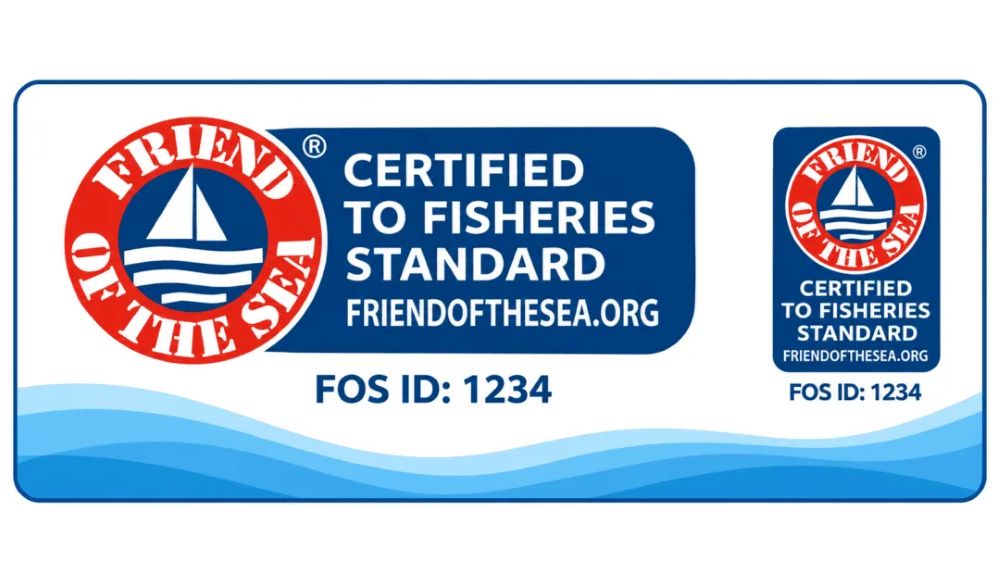
Friend of the Sea, the sustainability certification scheme of the World Sustainability Organization (WSO), is rolling out its new labels for certified products and services. Each label combines the round Friend of the Sea logo with a clear, sector-specific certification claim, and is accompanied by a unique FOS ID that links the claim to its verified and authorised certification.
The update is aligned with Directive (EU) 2024/825 on Empowering Consumers for the Green Transition (“EmpCo”), which applies in EU Member States since 27 September 2026 and introduces stricter requirements for environmental claims and labels, strengthening protection against misleading environmental communication.
A label that says exactly what is certified
The label contains the round Friend of the Sea logo, a specific certification claim (for example “Certified to Fisheries Standard”) and the Friend of the Sea web address, and is accompanied by the FOS ID traceability code, placed directly below it. Dedicated labels and claims are available for each certified sector, from fisheries and aquaculture to omega-3, marine collagen and sunscreen, among the 22 standards covered by the Official Product Claims Register. Companies can therefore communicate precisely what has been certified, while consumers receive clearer and more specific information at a glance. The round logo remains the anchor of the label, a mark in use since 2008, now accompanied by a clear statement of what it stands for.
Built on accreditation, independence and sustainability in its full sense
EmpCo requires sustainability labels to be based on a certification scheme or established by public authorities. Friend of the Sea believes it has always been aligned with this approach, because its certification rests on:
- Independent, accredited certification: on-site audits by independent certification bodies accredited to ISO/IEC 17065 by national accreditation bodies that are signatories of the Global ACI mutual recognition arrangement, such as Accredia (Italy), ANAB (United States), SLAB (Sri Lanka) and KAN (Indonesia).
- Global ACI endorsement: Friend of the Sea’s seafood standards are an endorsed scheme of Global ACI (Global Accreditation Cooperation Incorporated, formerly IAF), and Friend of the Sea is the only fisheries certification scheme accredited by a national accreditation body, Accredia, in line with ISO/IEC 17065.
- Sustainability as a whole: criteria addressing the environmental, social and economic dimensions, including, for example, requirements on workers’ rights and safety.
- Traceability, monitoring and accountability: chain of custody requirements, ongoing monitoring of label use, and tools such as satellite-based vessel tracking where applicable.
“Trust is at the heart of credible certification. We believe Friend of the Sea has always been aligned with the spirit of this Directive, because our certification is independent, accredited and addresses sustainability as a whole. With the new labels we have chosen to make our message even more specific, trusting the power of the logo itself: the round Friend of the Sea logo, a clear claim on what is certified and a FOS ID that anyone can check. This strengthens the connection between certified companies and the people who choose their products” added Paolo Bray, Founder and Director of Friend of the Sea.
FOS ID and optional claims: always clearly connected to the label
FOS ID: Shown in the format “FOS ID: 1234”, it links the label to the certified product and to the company producing it, and to the certificate’s validity and expiration date, offering consumers greater traceability and certified companies additional protection. It must be placed directly below the label, so that it is easily and clearly connected to it.
Optional explanatory claims: The label already states the certified standard. Companies that wish to describe the scope of certification in more detail may add one pre-approved text from the Official Product Claims Register (compact, standard or extended), reproduced without modification. These claims are optional and not mandatory, so that smaller packs are not penalised by space constraints. When used, they should be placed directly next to or below the label and the FOS ID.
Guidelines and claims in 24 languages
Friend of the Sea has produced label claims and optional explanatory claims in up to 24 languages, depending on the standard. They cover 14 of the EU’s 24 official languages and many of the world’s most widely spoken languages, including English, Chinese, Hindi, Spanish, French, Arabic and Portuguese, so that companies can display the version matching the official language of each market. Where a language is not yet available, an official version can be requested from WSO.
The Logo and Label Usage Guidelines set out the official label variants, colours, minimum sizes, clear space, FOS ID placement and uses to avoid. Certified companies are also asked not to combine the label with generic, unverified environmental statements, and to state clearly when certification applies only to a specific ingredient or component.
A pragmatic approach to adaptation. Although WSO strongly recommends the use of the official labels, it takes a pragmatic approach and allows companies to adapt the layout of the claim, the URL and the FOS ID to their on-pack space requirements, graphic design, colours and font, without changing their content. All adaptations must be submitted to and formally approved in writing by WSO / Friend of the Sea before printing.
The updated labels and guidelines are being progressively introduced across Friend of the Sea certified products and communications.
Robban Assafina is now on WhatsApp channel. Click Here