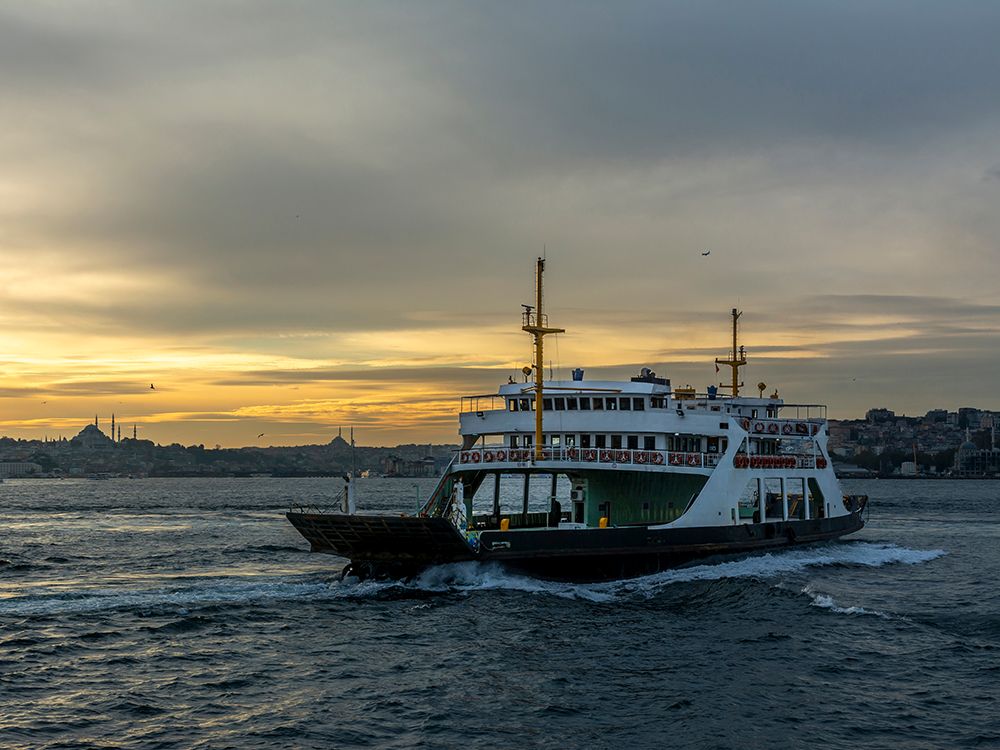
Türkiye’s Sea of Marmara ferry network could cut greenhouse gas emissions by 63% by switching to a mix of hybrid and fully electric vessels, while avoiding nearly half a billion euros in health and environmental damage costs and supporting around 1,100 jobs a year, according to a new IMO study.
Commissioned by IMO’s GreenVoyage2050 programme in partnership with Türkiye’s Ministry of Transport and Infrastructure, the study assessed 67 Ro-Ro and Ro-Pax ferries carrying vehicles and passengers across 26 ports. The network transports around 25 million passengers and seven million vehicles each year.
Significant potential to cut emissions
The study found that battery-electric and hybrid propulsion are technically feasible options across all Ro-Pax and Ro-Ro ferry operations assessed in the Sea of Marmara.
It identified an optimum scenario combining hybrid and fully electric vessels to balance emissions reductions and costs. Under this scenario, annual GHG emissions could fall by around 63% by 2050 compared with business-as-usual operations using diesel fuel.
The transition would also reduce local air pollution and could avoid an estimated €492 million in cumulative health and environmental damage costs.
Going further, converting the entire fleet to fully electric operations could cut GHG emissions by 84% by 2050. This could rise to as much as 95% if Türkiye’s electricity grid decarbonizes in line with its 2053 net-zero target.
The study identified no major technical barriers to electrification. The main challenges to large-scale deployment are charging infrastructure, upfront investment, coordinated energy planning and the domestic regulatory framework.
Building on Türkiye’s shipbuilding strength
Ferry electrification would build on Türkiye established shipbuilding expertise, boosting clean technology industries in the country and reducing reliance on imported marine fuels.
Under the optimum hybrid-electric scenario, the required investment could support an average of around 1,100 jobs a year through to 2050. Vessel construction and retrofit jobs are expected to be concentrated in Turkish shipyards.
Moving towards implementation
To turn these findings into action, the study recommends a coordinated approach involving government, municipalities, ports, ferry operators and the energy sector.
Priority actions include:
- expanding shoreside charging infrastructure and high-voltage grid connections at ports, supported by long-term port concessions that include charging infrastructure;
- securing a low-carbon electricity supply at ports, including by allowing ports to generate, use and sell locally produced low-carbon electricity;
- introducing targeted financial incentives, mobilizing blended finance, and using emissions-based port fees to encourage cleaner vessels;
- integrating electrification into transport and energy planning;
- embedding environmental criteria into public ferry procurement; and
- supporting detailed feasibility studies and pilot projects that can demonstrate commercial viability before wider deployment.
GreenVoyage2050 and Türkiye’s Ministry of Transport and Infrastructure are now looking to advance a first pilot electrification project in the Sea of Marmara to demonstrate the technical, environmental and commercial benefits identified in the study.
Robban Assafina is now on WhatsApp channel. Click Here