China has launched its largest hydrogen-powered inland freight vessel, marking a significant milestone in the country’s efforts to reduce emissions from river transport through the use of domestically developed hydrogen fuel-cell technology.
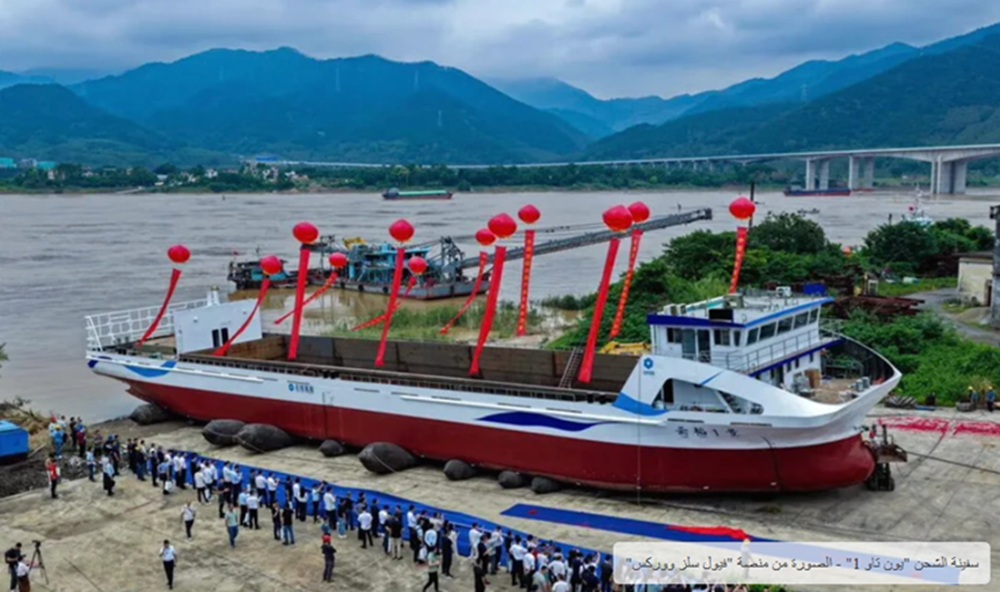
The 2,000-tonne “Yun Tao No. 1” was launched on July 16 at a ceremony in Zhaoqing. The vessel is being developed and built by Guangdong Yuntao Hydrogen Energy Technology Co., Ltd. and China Shipbuilding Group, with the project presented as a breakthrough for China’s independent industrial chain in large-scale inland hydrogen-powered freight shipping.
The launch comes as China moves into its “15th Five-Year Plan” period with hydrogen energy and new-energy systems positioned more firmly in transport policy. The country’s “Energy Field Energy Conservation and Carbon Reduction Action Plan (2026-2028)” calls for green fuel alternatives to be promoted for inland waterway vessels, giving projects such as “Yun Tao No. 1” a clear policy tailwind.
As China’s largest hydrogen-powered freight ship, “Yun Tao No. 1” is equipped with a 100% localized marine fuel-cell system. Yuntao Hydrogen Energy says the vessel combines zero-carbon operation, long service life, lower operating cost and safety advantages, while creating a standardized inland hydrogen-shipping demonstration route that can be copied and scaled.
The vessel is designed for heavy-duty freight on rivers, not a showcase cruise. It fills a domestic technology gap for large-tonnage hydrogen-powered ships and is aimed at real cargo movement across inland waterways.
“Yun Tao No. 1” is 70 meters long and 14 meters wide, with a range of 760 kilometers. It can carry around 140 containers or bulk cargo such as ore, coal and grain. That gives it the size and operating profile needed for commercial inland freight, rather than a limited pilot vessel built only for publicity.
Yuntao says the vessel also supports priority scheduling at core inland hub nodes, stable and declining energy costs and improved crew operating space. The company is positioning the ship as an integrated solution for inland shipping operators that want lower emissions without giving up load capacity, safety or operating economics.
Yang Qiang, chairman of Yuntao Hydrogen Energy, said the jointly built “Yun Tao No. 1” abandons the experimental design approach and instead uses a mature commercial hydrogen energy program. He said the vessel directly incorporates several core water-transport technologies while combining carbon-reduction and cost advantages.
The powertrain is built around Yuntao Hydrogen Energy’s independently developed integrated hydrogen fuel-cell power system. The vessel uses three 260 kW marine hydrogen fuel-cell generator sets, supported by lithium battery extension.
The company says the system delivers heavy-load capability, long endurance and low hydrogen consumption. It also includes intelligent energy management and multi-layer hydrogen safety protection, with the full operating process designed for zero carbon, zero noise and zero pollutant emissions.
The hull has been optimized for low resistance, while intelligent navigation early-warning systems are intended to improve safety. Yuntao says the vessel can adapt to complex inland waterway conditions, including shoals, rapids and ecological-control zones.
Under equivalent route and tonnage conditions, the ship is expected to deliver a 760-kilometer operating range and hydrogen consumption of about 1 kilogram per kilometer. Yuntao says fuel operating costs are 25% to 30% lower than comparable traditional diesel vessels.
That cost claim matters. Hydrogen shipping will not scale on environmental appeal alone. Inland freight operators run on margins, schedules and reliability. If hydrogen vessels are more expensive to operate, adoption will stall. If Yuntao can prove lower fuel operating costs in daily service, the project becomes far more important.
The company is also thinking beyond one vessel. Yuntao Hydrogen Energy is leading the formation of a hydrogen ship innovation consortium and plans to deploy 100 standardized hydrogen vessels in the Pearl River region within four years.
Its goal is to improve hydrogen refueling support and achieve sustainable commercialization of hydrogen ships without subsidies by 2028. That is an ambitious target, and it should be judged carefully. Hydrogen vessels need more than good ship design. They need fuel availability, bunkering safety, maintenance capability, route planning and stable freight demand.
On the same day as the launch, the China Hydrogen Shipbuilding Industry Innovation Consortium was formally established under Yuntao Hydrogen Energy’s leadership. The first group includes nearly 40 companies covering ship design, equipment manufacturing, materials research and development, operating services and other links in the hydrogen-vessel supply chain.
That consortium approach is important because marine fuel-cell deployment is not a single-company problem. It requires coordination across shipyards, fuel-cell suppliers, hydrogen storage systems, vessel operators, port authorities, refueling providers and safety regulators.
Yuntao also released a full range of hydrogen energy products covering land, water and air applications. The company is positioning itself as one of the first hydrogen energy firms to build a closed loop across production, storage, transport and multi-scenario deployment.
China is trying to move hydrogen inland shipping from demonstration into industrialization. The “Yun Tao No. 1” launch gives the country a large, domestically integrated platform to test that ambition on real freight routes.
The vessel must now prove endurance, fuel cost, uptime, safety and refueling efficiency in daily operation. A 2,000-tonne hydrogen ship is impressive on paper. What matters is whether operators can make money with it.
If Yuntao can deliver its 100-vessel plan and reach subsidy-free commercialization by 2028, China’s inland shipping sector could gain one of the world’s most serious hydrogen freight demonstrations. If it cannot, “Yun Tao No. 1” will still be an important technical milestone, but not yet proof of a scalable market.
For now, the launch marks a real step forward. China has put a large hydrogen-powered inland cargo ship into the water with a local supply chain, a defined route strategy and a commercialization target. That is exactly the kind of practical deployment hydrogen needs if it is going to move beyond speeches and into freight work.
Robban Assafina is now on WhatsApp channel. Click Here