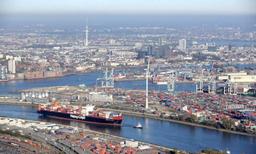
The head of the Jordanian Logistics Association, Nabil Al-Khatib, said that the port of Aqaba, the kingdom's only sea outlet, has been operating at an "excellent" pace in performing its vital role as the main economic artery for Jordan, despite the repercussions of the war launched by the United States and Israel against Iran on March 28. In an interview with CNN Arabic, Al-Khatib discussed the most prominent challenges facing maritime shipping in general, and in the port of Aqaba in particular, considering that there is a golden opportunity for the ports of Aqaba to become a logistics center for shipping, especially with the receipt of requests related to transporting goods by land to the Gulf countries.
Al-Khatib explained that all ships scheduled to arrive at the port of Aqaba during the month of March arrived without any stop or change in their destination, with a total of 147 ships, including 46 ships dedicated to transporting containers with a cargo exceeding 70,000 standard containers, so that the flow of basic goods such as wheat, foodstuffs, oil derivatives and gas continues, stressing that the supply movement is continuing at an excellent pace. The first week of April carries positive indicators, according to Al-Khatib, reflecting the continuation of supply chains, noting the scheduled arrival of about a dozen additional ships during this week.
Regarding the most significant impacts on the maritime shipping sector, Al-Khatib said that fuel prices used in ships have risen unreasonably, in addition to the burdens of emergency marine insurance on ships. Al-Khatib explained that the percentage increase in shipping fees varies according to the loading ports, ranging between 25% and 100%, noting that the impact of this on the final prices of goods is limited in the local Jordanian markets "so far".
Al-Khatib pointed out that Jordan’s strategic wheat reserves are sufficient for nine months, which is among the highest levels of reserves among neighboring countries, stressing that the Jordanian government has taken swift measures since the early days of the crisis to ensure the continuity of supply chains. Regarding the impact on the transit of several major international shipping companies through the Red Sea, Al-Khatib explained that some companies were not using the Red Sea, while others preferred to circumnavigate the Cape of Good Hope.
He added, "Some international shipping companies opted for the Cape of Good Hope route instead of transiting the Red Sea, which led to delays of approximately three weeks in the arrival of some goods and increased costs. However, the Port of Aqaba continued to operate."
Regarding alternative shipping plans to the port of Aqaba in the event of disruptions in the Red Sea, Al-Khatib said that the Cape of Good Hope route is available and ready, and if Bab al-Mandab is closed, the cost may increase and the time may be longer, but supply chains will continue without interruption. He explained here that Jordanian goods are sorted in Mediterranean ports, whether they are Egyptian, Syrian or Turkish, and then transported to Jordan by land or by (small and medium) feeder ships that return to enter the Suez Canal and the Red Sea, stressing that this issue is resolved. Regarding other goods coming from America, Europe, the Balkans, the Black Sea, and the Mediterranean, Al-Khatib said they would not be affected even in the event of a closure, because the Suez Canal remains the only outlet, "and they are not affected by either time or cost," he said.
He explained that the only potential impact would relate to fines or fees to cover temporary wars or regional conflicts. In a related context, Al-Khatib revealed a new activity for land and sea routes for transit goods heading to the Gulf countries. He said that many goods have begun to arrive at the port of Aqaba via transit to the Gulf countries and Iraq, noting the arrival of a ship in Aqaba loaded with 80,000 tons of sugar heading to Iraq, which is currently being unloaded, in addition to other ships expected during the coming week, along with many containers heading to the Arab Gulf countries. Al-Khatib considered this an opportunity that can be utilized and maximized by making Aqaba a logistics hub for shipping, stressing that "this performance should continue and not only in wars."
He said that if the merchant continues to receive the service, uses the port of Aqaba, and all procedures are sound and correct and costs are reasonable, he will continue to ship goods, especially goods coming from Northern Europe and the Mediterranean that enter through the Suez Canal. He stressed that daily coordination between the public and private sectors is ongoing, including the Amman Chamber of Commerce, the Logistics Syndicate, and the shipping and customs clearance syndicates, which has contributed to reducing the negative effects of the crisis on trade and shipping, even though Jordan was not a party to the war, but is affected by its repercussions due to its connection to global supply chains.
Regarding the data issued by the Aqaba Development Corporation on the operational status and ship traffic in Aqaba ports, it showed that during March, 147 ships arrived, including 46 container ships, 9 phosphate ships, and 11 ships loaded with crude oil, gasoline, jet fuel, crude oil, vegetable and mineral oils, and others, in addition to 8 ships via the liquefied petroleum gas terminal loaded with liquefied petroleum gas carrying 74,000 tons. During the same period, the new Aqaba port also received 37 ships loaded with wheat, sheep, cars, sheet iron rolls, barley, fodder, coal and compressed wood, while the Sheikh Sabah LNG port received two ships loaded with a total of 128,000 tons of LNG. According to that data, 35 different ships are expected to arrive during the first week of April.
Robban Assafina is now on WhatsApp channel. Click Here