
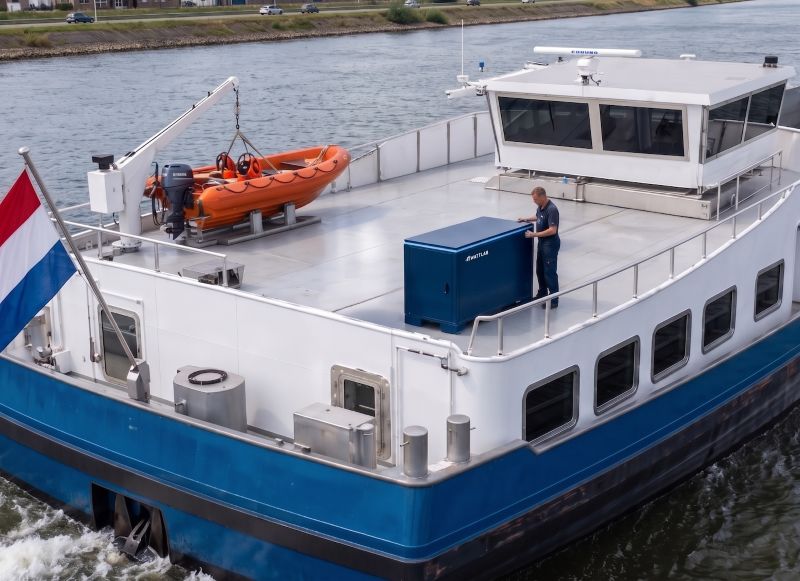
Wattlab is pitching a one-day-install, factory-tested battery system at the inland shipping sector’s most persistent inefficiency: diesel generators running at a fraction of their rated capacity for most of their working lives.
Wattlab has introduced WEstack, a standardized battery system for inland vessels available in four capacity variants. The Dutch maritime tech company said it could reduce diesel generator running hours by up to 90%.
WEstack is fully assembled and tested at Wattlab’s workshop before delivery, requiring only a single day of onboard installation rather than the weeks typically needed for custom marine battery systems. The system is installed on the aft deck and is designed for both newbuild and retrofit applications across a range of inland vessel types, from dry cargo ships to tankers and small coastal freighters.
The system is available in four standardized capacities: 100 kWh, 200 kWh, 300 kWh, and 400 kWh. Wattlab said generators on inland vessels often run at around 10% to 15% of their capacity, which the company described as highly inefficient because generators consume a disproportionate amount of fuel at low load.
The WEstack is designed to allow the generator to operate at optimal output to charge the battery, after which the battery covers much of the vessel’s onboard electrical load. Wattlab said the system is intended to reduce generator running hours by 80% to 90%, resulting in lower fuel consumption, reduced maintenance costs, and lower CO₂ emissions, as well as less noise and vibration on board.
Wattlab said the standardized design keeps costs lower than bespoke systems and allows faster production and installation, offering what it described as a more affordable and scalable alternative for vessel owners.
Bo Salet, founder and CEO of Wattlab, said port access requirements are also driving interest in battery systems. He said more ports are seeking to limit emissions and noise, and that the WEstack allows vessels to operate on battery power for extended periods without exhaust emissions, reducing reliance on shore power.
Wattlab was founded in 2017 and built its profile through large-scale solar installations on inland vessels, including a Guinness World Record for the largest solar panel installation on an inland ship aboard the MS Helios in 2024. Its technologies have been deployed on more than 30 vessels globally. The company also develops the Solar Flatrack, a modular solar system for seagoing vessels. Salet said alternative fuels will remain scarce and expensive for the foreseeable future and that energy efficiency is, in the company’s view, the fastest and most economical route to reducing shipping sector emissions.
Last year, Wattlab delivered a solar energy system for HGK Shipping’s Blue Marlin, an 86-meter inland dry-cargo vessel operating on the northwest German canal network. It described it as the first inland vessel capable of hybrid solar-powered sailing with direct solar-to-propulsion integration. The company also has a contract to install a solar system on the BRF Froan, described as the world’s largest zero-emission battery-electric bulk carrier, expected to enter service this year
Robban Assafina is now on WhatsApp channel. Click Here


