
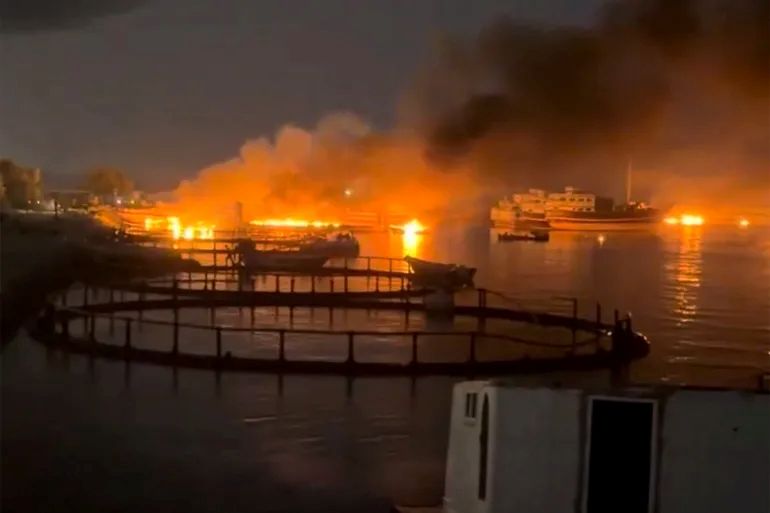
The United States and Iran continued exchanging military strikes as tensions intensified across the region, with Washington carrying out a third consecutive night of attacks against Iranian targets ahead of the implementation of a renewed naval blockade on Iranian ports. The escalation comes as both sides assert control over the strategically vital Strait of Hormuz, raising concerns over regional security and the potential impact on international maritime traffic and global supply chains
US Central Command, the military’s regional command known as CENTCOM, said its latest strikes began at 4:45pm ET (20:45 GMT) on Monday, and were aimed at degrading Iran’s capacity to attack “innocent civilians and commercial shipping” in the strait.CENTCOM later announced the conclusion of its strikes and said the latest round of attacks on Iran lasted five hours. It added that US forces “successfully struck military targets across Iran including Bushehr, Chah Bahar, Jask, Konarak, Abu Musa, and Bandar Abbas”.
Iranian state television and semi-official news agencies reported explosions throughout the night across the country’s southern coast, including the port city of Bandar Abbas, and on Kish and Qeshm islands, as well as the town of Jam in Bushehr province. Iranian media say at least four people were wounded in a US attack on the southwestern city of Omidiyeh.
A projectile that struck western Bandar Abbas caused no casualties, the Fars news agency reported, citing the regional governor’s office. In the
Iran’s Tasnim news agency reported that Iranian forces had struck several “violating” vessels in the strait, and that a US-made drone had been shot down near Bandar Abbas.
Iranian strikes
The United Arab Emirates said that two of its oil tankers had been hit by Iranian cruise missiles in Omani waters in the Strait of Hormuz. The UAE added that one Indian national crew member had been killed on one of the tankers, and that eight other people were wounded.For its part, Iran’s Islamic Revolutionary Guard Corps (IRGC) said it had also launched a wider retaliatory campaign against US allies and interests across the Gulf and in Jordan.
The Iranian army said on Monday that it had carried out a drone attack on US military targets in Kuwait. In a statement posted by state broadcaster IRIB, the army said it launched drones at a US Patriot missile system, fuel tanks, a watchtower, an ammunition depot and communication systems.
The IRGC said it targeted “several weapons storage depots, a satellite communications center, and a building housing US forces” at al-Juffair Base in Bahrain. It also said it had targeted the US Fifth Fleet in Bahrain with missiles and drones. Attacks continued in the early hours of Tuesday with Bahraini authorities activating air raid sirens at least three times.
Iranian forces also said they launched ballistic missiles at US forces at an airbase in Jordan, hours after the Jordanian army said it shot down four missiles.
Earlier on Monday, Iran struck targets in Bahrain, Jordan, and Kuwait again.
US President Donald Trump formally notified Congress on July 10 that fighting with Iran had resumed on July 7, invoking his authority to keep US forces in combat for another 60 days without lawmakers’ approval.
Senior Democrat Chuck Schumer criticised the decision to resume hostilities. “The House and Senate both voted to remove our forces from harm’s way and end this war now. Trump must comply,” he said in a post on X.
The US blockade on Iran, confirmed by the US Navy-led Joint Maritime Information Centre (JMIC), is due to begin at 20:00 GMT on Tuesday.
It marks the rapid collapse of a ceasefire reached in June under a US-Iran memorandum of understanding, as the two sides now fight over a waterway through which roughly a fifth of the world’s oil passed before the US and Israel began their war on Iran in February.The US’s blockade covers Iran’s ports and terminals along the entire southern coastline, according to JMIC.
Vessels headed to destinations other than Iran will still be allowed through the strait, and humanitarian shipments will be permitted after inspection, it said, but ships suspected of helping Iran evade the blockade through ship-to-ship transfers face boarding, and those that fail to comply risk being disabled or destroyed.
The Strait of Hormuz
The war of words over who controls the Strait of Hormuz continued on Monday, with Trump insisting again that the strait was open and announcing a 20 percent toll on cargo shipped through it in exchange for US protection.Iran’s foreign minister, Abbas Araghchi, rejected the US president’s claim, saying Tehran “has always been the guardian of the strait and will remain so forever”.
At a news conference on Monday, Trump said Iran’s offensive capabilities were being dismantled, but he still thinks a “deal is possible” despite the return to open fighting.Al Jazeera’s Mike Hanna, reporting from the White House, said the fighting did not necessarily rule out a return to talks.
“The ceasefire is over, but the negotiations are still there,” he said, adding that Washington wanted to keep alive “the concept of negotiations” even if none were under way, because the administration remained eager to secure a deal.
Trump also repeated his demand that Gulf nations help cover the cost of protecting shipping, saying Washington was “protecting a very rich portion of the world” and expected to be paid for it.
The current escalation follows weeks of tit-for-tat strikes that steadily wore down the June ceasefire, as Iran and the US clashed over who has authority to control traffic through the strait.
Oil prices have surged to a four-week high, with Brent crude futures gaining $1.68, or 2 percent, to reach $84.98 a barrel in early trade.
Kpler, the ship-tracking firm, said crossings through the strait fell by about 52 percent between July 10 and July 12 compared with the previous week.
Robban Assafina is now on WhatsApp channel. Click Here


