The International Maritime Organization’s Sub-Committee on Pollution Prevention and Response (PPR) convenes for its 13th session from 9–13 February 2026 at IMO Headquarters in London.
The Sub-Committee is responsible for all matters relating to marine pollution prevention and response within IMO’s remit, including MARPOL annexes, ballast water and biofouling management, anti-fouling systems, oil and hazardous substance pollution preparedness and response, and ship recycling. The session will bring together IMO Member States, intergovernmental organisations, industry associations and environmental NGOs to advance regulatory and technical work on key environmental issues.
Overview of the provisional agenda
- Adoption of the agenda (formal opening business)
- Decisions of other IMO bodies (carry-over and coordination)
- Safety and pollution hazards of chemicals — consequential amendments to the IBC Code
- Amendments to MARPOL Annex II to improve tank stripping, tank washing and prewash for high melting-point/high-viscosity products
- Development of a legally binding framework for controlling and managing ships’ biofouling to reduce invasive species transfer
- Reduction of Arctic black carbon emissions from international shipping (Polar fuel / Arctic measures)
- Evaluation and harmonization of rules and guidance on exhaust gas cleaning system (EGCS) discharge water (including regulatory options)
- Review and development of NOx requirements in MARPOL Annex VI and the NOx Technical Code 2008
- Amendments to NTC 2008 to allow certification of engines operating on non-carbon or mixed fuels
- Revision of MARPOL Annex IV (sewage) and associated guidance
- Follow-up work from the Action Plan to Address Marine Plastic Litter from Ships
- Revision of specifications/guidelines for pollution prevention equipment for machinery space bilges (MEPC.107(49))
- Review of IBTS Guidelines and amendments to IOPP Certificate and Oil Record Book
- Unified interpretation of provisions of IMO environment-related conventions
- Biennial agenda and provisional agenda for PPR 14
- Election of Chair & Vice-Chair for 2027
- Any other business
- Report to the Marine Environment Protection Committee (MEPC)
These discussions form part of IMO’s ongoing effort to strengthen environmental protection while supporting safe and efficient maritime operations.
EGCS discharge water and regulatory consistency
Agenda item 7, addressing the evaluation and harmonisation of rules and guidance on EGCS discharge water, remains one of the most closely watched issues.
According to submissions highlighted by Andreas Chrysostomou, Executive Director of the Clean Shipping Alliance, the Sub-Committee will consider whether additional regulatory measures are required and how these should be developed within existing IMO frameworks. A proposal submitted by the European Union (PPR 13/7/2) seeks to amend Regulation 4 of MARPOL Annex VI to allow restrictions on EGCS discharge water within Particularly Sensitive Sea Areas (PSSAs) through new legal pathways.
IMO has already established methodologies for assessing EGCS discharge impacts through its 2022 risk assessment guidelines (MEPC.1/Circ.899), which recognise two scientific approaches:
- Emission-factor-based assessment
- Whole effluent toxicity (WET) testing
Further work to standardize emission factor calculations is being conducted by a GESAMP Task Team, although a final report is not expected before PPR 14 due to funding constraints.
Several submissions to PPR 13 from flag States and international shipping organisations, including Liberia, ICS, BIMCO, CLIA, and the World Shipping Council, have raised concerns that bypassing established IMO procedures could set a precedent extending beyond EGCS.
"If regulatory outcomes are advanced ahead of completed scientific work, and independent of IMO decisions, confidence in IMO frameworks risks being eroded, discouraging future investment in compliance technologies and innovation "… said Andreas Chrysostomou.
Arctic black carbon and the proposed Polar Fuel Standard
Reducing black carbon emissions in the Arctic is another major focus of PPR 13.
The Clean Arctic Alliance has called on Arctic States and IMO members to support stronger measures to reduce black carbon emissions from shipping. A proposal submitted by Denmark (representing Greenland), along with France, Germany and the Solomon Islands, recommends introducing mandatory requirements under MARPOL Annex VI for ships operating in the Arctic to use fuels that produce lower black carbon emissions.
The International Union of Marine Insurance (IUMI) has also highlighted proposals for a “Polar Fuel Standard” that would make mandatory the use of fuel oil in the Arctic that meets the following requirements:
- density shall not exceed 890 kg/m3 at 15°C;
- viscosity shall not exceed 6,000 mm2/s at 40°C or be lower than 2,000 mm2/s at 40°C; and
- carbon residue content by mass; micro method on the 10% volume distillation residue; maximum of 0.30% as measured by ISO 10370.
The proposal includes amendments to the Bunker Delivery Note to mandate the additional recording of items .2 and .3 above. If the proposal is progressed, entry into force would not be until late 2028 at the earliest.
If adopted, these requirements would likely enter into force no earlier than 2028, reflecting the time needed for technical development and implementation.
Emerging fuel issues: ammonia effluent management
The transition to alternative fuels introduces new regulatory challenges. At PPR 13, the Korean government delegation is expected to emphasize the importance of developing guidelines for ammonia effluent management and marine discharge standards.
Ammonia is gaining attention as a potential zero-carbon marine fuel, but it presents unique environmental and operational risks. Korea is proposing the formation of a dedicated Expert Group to support technical discussions and develop appropriate discharge and safety standards. This reflects the growing urgency of ensuring that new fuel technologies are supported by robust environmental regulations.
Biofouling and invasive species prevention
PPR 13 will continue work on developing a legally binding framework for biofouling management. Biofouling is recognized as a significant pathway for the transfer of invasive aquatic species, which can have severe ecological and economic impacts.
The development of binding requirements would represent a major step forward in strengthening global biosecurity protections and complement existing ballast water management measures.
Air emissions, engine certification and MARPOL Annex VI
The Sub-Committee will also review and update NOx emission requirements and certification standards under MARPOL Annex VI and the NOx Technical Code 2008. This includes developing certification pathways for engines operating on alternative fuels, including non-carbon fuels such as ammonia and hydrogen.
These discussions are essential to ensure that regulatory frameworks remain aligned with technological innovation and IMO’s greenhouse gas reduction goals.
Arsenio Dominguez highlights the importance of advancing environmental protection
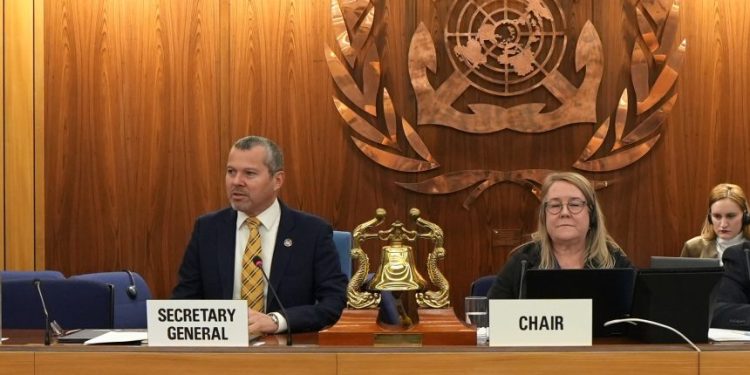
IMO Secretary-General Arsenio Dominguez welcomed delegates to the 13th session of the Sub-Committee on Pollution Prevention and Response (PPR), highlighting the 2026–2027 World Maritime Day theme: “From Policy to Practice: Powering Maritime Excellence”.
He emphasized the need to translate IMO regulations into effective national legislation and day-to-day maritime operations, with the PPR Sub-Committee playing a key role in turning environmental commitments into practical standards.
According to Dominguez, the session will address:
- MARPOL Annex I: Finalizing oily waste handling guidelines.
- MARPOL Annex II: Assessing chemical transport hazards.
- MARPOL Annex IV: Ensuring long-term performance of sewage treatment plants.
- MARPOL Annex V: Tackling marine plastic litter.
- MARPOL Annex VI: Reviewing NOx emission control, Black Carbon in the Arctic, and exhaust gas cleaning water discharge.
- Biofouling: Developing a legally binding management framework based on previous guidelines.
With 154 submissions, the session reflects strong engagement and the challenge of turning policy into effective practice. Dominguez expressed confidence in delegates’ progress under Chair Dr. Anita Mäkinen and invited everyone to the welcome reception.