
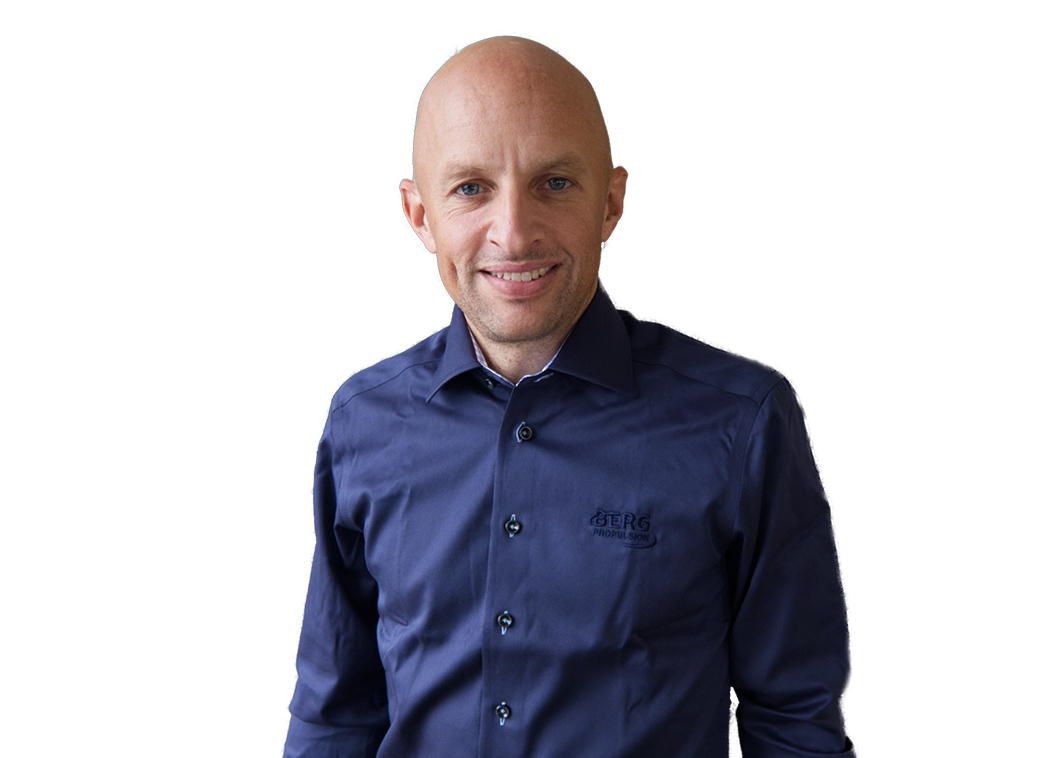
Artificial intelligence (AI) is accelerating marine system innovation, but its value relies on strong engineering governance, structured data and clear processes, writes Tobias Huuva, Engineering Manager, Berg Propulsion
Like other engineers, those focusing on marine propulsion find AI and machine learning (ML) increasingly useful for enhancing productivity and consistency in documentation, as well as enabling data-driven decisions over the system lifecycle. But as also experienced elsewhere, the extent of this usefulness depends on applying these tools with a clear engineering purpose.
This is because the real “enabler” is not the algorithms themselves, but remains the foundation of well-organised data, clearly defined workflows, and experienced engineers who understand both the problem and the tools. At Berg Propulsion, we treat AI strictly as an addition to established engineering practices—not a replacement.
Traditional engineering methods remain central to propulsion system design. Experienced engineers are always responsible for final decisions, and their judgement is essential. Developing propulsion systems is a multidisciplinary endeavour, involving hydrodynamics, mechanical design, electrical integration, and validation work such as sea trials.
Propeller design alone involves analysing vessel characteristics and operating profiles, running simulations, and carrying out model tests, all of which are time-intensive processes.
Supporting the engineering workflow
Today’s AI and ML tools are mature enough to support these processes without disrupting them. Used correctly, they can ease bottlenecks in the workflow, particularly where large volumes of data need to be handled quickly. However, it remains critical that engineers review and validate all AI-supported results.
And it is long experience in hydrodynamics and propulsion technology, covering solutions ranging from controllable-pitch propellers to complete propulsion systems, that puts Berg in the position to harvest full value of these new tools.
Many of our applications, such as tugboats, place very high demands on aspects of performance that serve different ends. Requirements like bollard pull, fast thrust response, precise low-speed control, and energy efficiency all need to be balanced.
AI is helping Berg Propulsion engineers overcome the heavy workload and repetitive data-processing tasks they face in documentation, software programming, analysis, and design evaluation - allowing them instead to focus more on critical thinking.
Using the right tools in the right way
Different AI tools are also used for serve different purposes, and can be used individually or in combination.
Machine learning models, for example, are well suited for approximating relationships between propeller geometry, operating conditions, and performance metrics such as efficiency, thrust, cavitation, and noise. Once trained, these models can provide rapid performance predictions that support early-stage design decision-making.
Large Language Models (LLMs), on the other hand, are most useful for text-based work—drafting reports, reviewing documentation, and ensuring consistent terminology. These tasks often take up a significant amount of engineering time, and automation here allows engineers to stay focused on analysis and decision-making.
At Berg Propulsion, we are also working on agent-based solutions that combine LLMs with controlled access to internal data. These systems can retrieve approved templates, historical project data, and technical information while respecting governance rules. They can also respond to internal technical questions, support regulatory interpretation, and help prepare documentation tailored to specific customers.
For more advanced hydrodynamic work, graph neural networks (GNNs) offer interesting possibilities. By representing geometry and flow behaviour as interconnected structures, they can capture complex spatial relationships that are difficult to model with traditional regression-based methods. These tools are not intended to replace high-fidelity simulations but to complement them with quicker insights.
Active learning models provide another approach which offers promise for shortening propeller optimisation analysis. Instead of relying on predetermined algorithms and large numbers of simulations - as in traditional optimisation methods - it uses adaptive models that improve over time. This allows engineers to explore design alternatives more efficiently and reduce development time.
Digital twins add another layer of value. By combining sensor data with simulation models, they benefit performance monitoring, fault detection, and predictive maintenance. In addition, operational data from real vessels can be fed back into the design process, benefiting understanding in future product development.
The importance of governance
As AI technologies evolve, they will become increasingly integrated into engineering work. In marine propulsion, as elsewhere, they can strengthen efficiency, consistency, and sustainability - but only if they are implemented carefully.
In the first instance, as a principle, use should be made of these tools in supporting roles before they are adopted for decision-related tasks. Therefore, strong governance is essential throughout the engineering process - with data always verified as reliable, problems clear and defined, assumptions transparent, and results properly validated.
Ultimately, AI is a powerful addition to the engineering toolbox—but its value depends on how well it is integrated with existing knowledge, processes, and expertise.
Robban Assafina is now on WhatsApp channel. Click Here


