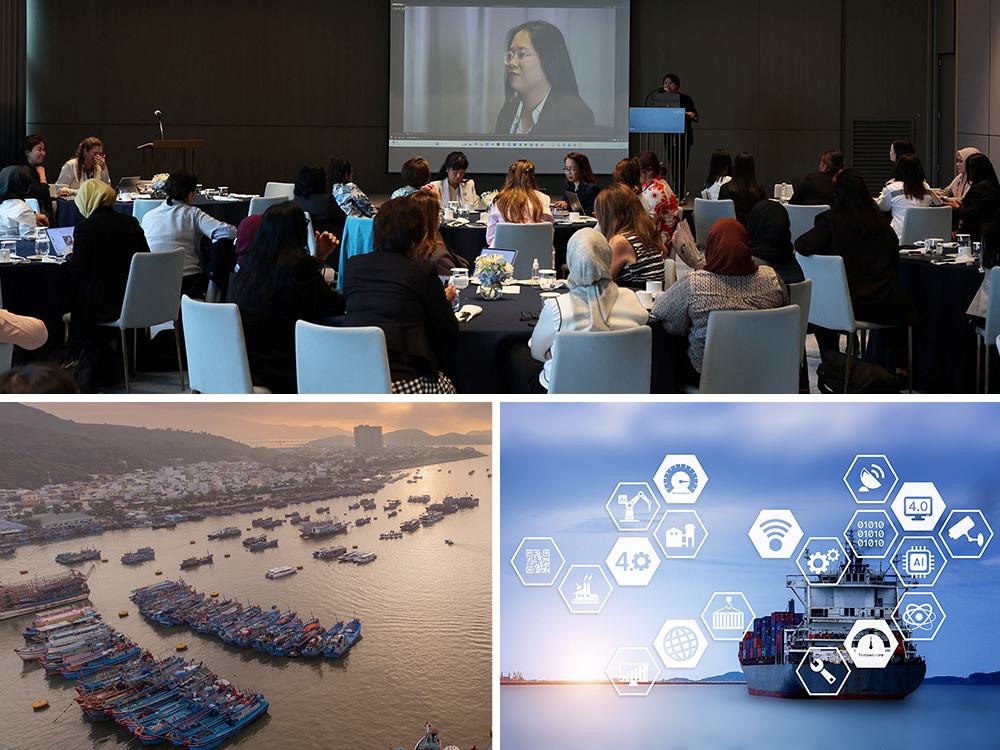
Women's participation and leadership in maritime digitalisation and decarbonisation in Viet Nam is set to be strengthened, under a new Maritime Sectoral Master Plan, which has been developed for Viet Nam under the IMO–Republic of Korea SMART-C Women Project.
The Master Plan, developed in collaboration with the World Maritime University (WMU) and Vietnamese stakeholders, provides a strategic framework to guide Viet Nam's maritime modernization of ports, logistics and governance, through digital transformation and green transition measures, while embedding gender equality as a cross-cutting theme across policy development, institutions and workforce capacity building.
Priorities are aligned with Viet Nam's National Master Plan (2021–2030 with a vision to 2050). The Maritime Sectoral Master Plan is intended to serve as a replicable model for other developing maritime nations in Asia and the Pacific.
Supporting maritime transformation
The Master Plan is built around three interdependent pillars:
- Gender Equality (cross-cutting) - promoting women's participation, leadership, safety and access to maritime education and employment;
- Digitalization - modernizing maritime services through digital systems such as Maritime Single Window; and
- Decarbonization - supporting the transition towards greener ports, shipping and maritime logistics operations.
The Master Plan draws on extensive stakeholder engagement coordinated with the Viet Nam Maritime and Waterway Administration (VIMAWA), involving representatives from government, academia and financial institutions in the maritime sector.
A stakeholder survey indicated perceptions of strong progress in digitalization already, alongside the need to further integrate gender considerations and address decarbonization challenges.
Capacity building and cooperation
To support implementation of the Master Plan's three strategic pillars, the Master Plan outlines a series of measures including leadership training for women, curriculum reform in maritime education, green financing mechanisms, and strengthened coordination among ministries, ports, training institutions and international partners.
The SMART-C Women Project will support this through training and knowledge-sharing activities, including online learning, field training, fellowships and international networking.
The Viet Nam pilot represents a key step under the SMART‑C Women Project, which is supporting the career development of women in developing countries across Asia and the Pacific, through targeted training, education, and international collaboration.
The project is part of IMO's commitment to inclusive, resilient and sustainable maritime development. It contributes directly to the UN Sustainable Development Goals, particularly SDGs 4, 5, 9, 13, 14 and 17, and strengthens IMO's overall mission to ensure women are fully represented in the maritime sector's transformation.
Robban Assafina is now on WhatsApp channel. Click Here