The South Korean Ministry of Trade, Industry and Energy announced it will invest 320 billion won this year to secure "super-gap" technology for the Korean shipbuilding industry, a 23% increase compared to last year.
The ministry stated that Korean shipbuilding exports reached $31.8 billion last year, their highest level in eight years, contributing to the country's total exports exceeding $700 billion.
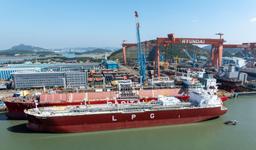
Korea's share of global shipbuilding orders reached 20.2%, a 6.2% increase from the previous year, and the country regained its leading position globally in high-value-added vessels such as very large liquefied natural gas (LNG) carriers.
However, reports indicate that enhancing the competitiveness of small and medium-sized shipyards and ship equipment companies remains a challenge, given the pressure from competing nations, evolving global trends, and the concentration of orders among major shipbuilders.
Accordingly, the Ministry of Industry has decided to launch 34 new technology development projects with a total value of 42.7 billion won, focusing on three key areas for this year. First, the Ministry intends to expand investment in the development of environmentally friendly ship technologies.
The plan includes securing core technologies for future eco-friendly vessels, such as carbon-free propulsion, carbon dioxide capture and storage systems for engine exhaust, and electric propulsion systems for medium and large vessels.
The Ministry will also work to deploy specialized artificial intelligence technologies in the shipbuilding industry, encompassing all stages of manufacturing and navigation, including production processes and autonomous vessels.
Furthermore, the Ministry aims to enhance process automation and improve workplace safety by developing automated technologies for assembling medium and large vessels weighing tens of tons, and logistics management technologies using unmanned mobile robots.
In the field of autonomous vessels, the Ministry will launch a large-scale operational testing project involving approximately 30 domestically produced ships.
The plans include support for several areas such as icebreaker design technologies and the localization of their equipment, the development of electric propulsion systems for offshore wind power support vessels, the development of tugboats that integrate autonomous navigation technologies and environmentally friendly technologies, and the establishment of field operating systems based on robots.