

Shanghai has officially become the world’s second-most prominent shipping hub, according to the 2026 rankings in the Xinhua-Baltic International Shipping Centre Development Index (ISCDI) Report, published in collaboration between Baltic Exchange and Xinhua News Agency.
This annual report, which is now in its 13th year, ranks the world’s leading shipping centres based on a comprehensive evaluation of port factors, professional business services, and general environment.
Singapore has remained the world’s leading international shipping centre for the thirteenth consecutive year, achieving a score of 99.32 out of 100. Its position at the top reflects its strategic location and established maritime services spanning finance, insurance and legal expertise, as well as its importance to alternative fuel development and technological innovation.
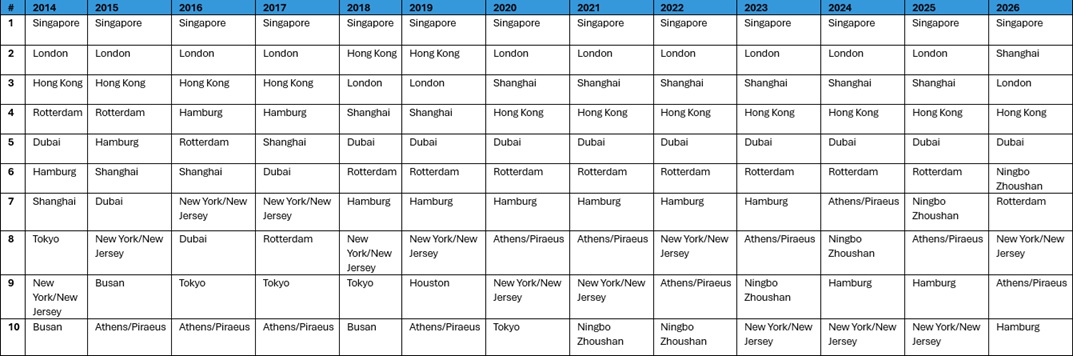
After years of steadily closing the gap, Shanghai (with a score of 84.27) overtook London (81.80) to become second in the 2026 index. Shanghai has consistently climbed from seventh place since the ISCDI was launched in 2014, marking the continued strengthening of its position as a global maritime centre for containerised trade.
London ranked third in this year’s index, followed by Hong Kong in fourth with 80.87 and Dubai in fifth with 77.13. All three shipping centres have remained in the top five alongside Singapore and Shanghai for nine consecutive years, underscoring the stability of the world’s leading global maritime centres.
Ningbo-Zhoushan rose one place to reach sixth with a score of 71.09 while Rotterdam fell one place with a score 70.22. Meanwhile, New York/New Jersey rose two places to eighth with a score of 69.50, overtaking Athens/Piraeus (68.76) and Hamburg (67.36) who both remain in the top 10.
Shanghai’s rise coincides with strengthened performance across China’s major shipping centres. Alongside Ningbo-Zhoushan, Guangzhou, Qingdao and Tianjin also recorded improved positions compared with last year, reflecting China’s growing maritime connectivity and service capabilities.
While no new maritime centres enter the top 20 this year, movement within the ranking highlights that, although established centres remain stable, competition among them is becoming increasingly dynamic.
Key findings of the 2026 ISCDI Report:
• Shanghai reaches second place: Shanghai has climbed consistently from seventh place in 2014 to become the world's second-ranked international shipping centre this year.
• China's shipping centres continue to strengthen: Ningbo-Zhoushan climbed to sixth place ahead of Rotterdam, while Guangzhou, Qingdao and Tianjin all improved their rankings compared with last year.
• Competition among established centres continues to intensify: Ongoing shifts within the top 20, alongside no new entrants in this year’s rankings, highlights the stability of the world’s leading shipping centres, yet intensifying competition among them.
The ISCDI report evaluates 43 international shipping centres using a comprehensive framework covering port performance, professional maritime services and the wider business environment. Indicators include cargo throughput, crane numbers, container berth length and port draught, alongside shipbroking, ship management, ship finance, insurance and legal services. The index also considers customs efficiency, digital government services and logistics performance.
Mr Mark Jackson, Chief Executive of Baltic Exchange, said,
"This year's Xinhua-Baltic International Shipping Centre Development Index Report is a reflection of the growth and importance of our global shipping hubs amid a continuing period of volatility in shipping markets. On behalf of Baltic Exchange, I would like to recognise all international maritime centres that keep our global trade moving and shipping sailing in the right direction."
Mr Cao Zhanzhong, Head of Xinhua Index Research Institute of China Economic Information Service, said,
“Our long-term research shows that competition among international shipping centres has evolved beyond port scale and route networks to encompass broader capabilities in green transition, digital innovation, maritime governance and global resource allocation. As the global trading system undergoes profound transformation and a new wave of technological revolution gathers pace, the international shipping industry is entering a new phase of development, bringing fresh opportunities while also facing increasingly complex challenges.”
Mr Ang Wee Keong, Chief Executive of the Maritime and Port Authority of Singapore, said,
“We are honoured that Singapore has once again been recognised as the world’s leading maritime centre. This reflects the strong commitment and collective efforts of our industry partners and the wider maritime community. As the industry continues to evolve, we will continue working closely with our partners to strengthen Maritime Singapore’s competitiveness and create value for the global maritime community.”
Global rankings of 2014 to 2026:
Robban Assafina is now on WhatsApp channel. Click Here


