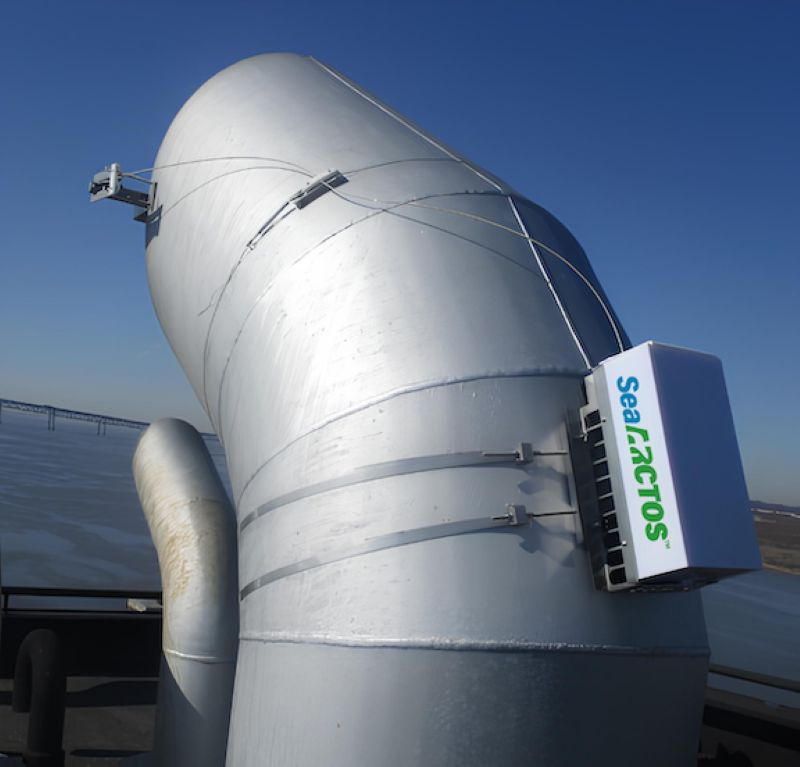
SeaARCTOS, has newly received Type Approval from Lloyd’s Register (LR) for carbon dioxide (CO2) emissions monitoring and reporting using its ARCTOS-1™ system.
ARCTOS-1™ is a MARPOL-approved and globally patented stack-mounted monitoring device that continuously measures CO₂, sulphur dioxide (SO₂), and methane (CH₄) exhaust emissions. The technology has completed over 20,000 hours of at-sea testing. It weighs less than 3.5 kg, is no larger than a shoebox, and is powered by waste heat from the exhaust. Installation takes less than an hour and requires no welding, cutting or power tools.
Fredrik Fuglesang, CEO of SeaARCTOS, commented: “FuelEU Maritime, the EU Emissions Trading System, and the IMO Net-Zero Framework, if it is adopted, are only as effective as their enforcement mechanisms. Efficient, consistent and tamper-proof emissions monitoring gives regulators, port authorities and flag states the vital evidence they need to penalise non-compliance or reward over-compliance.
“Direct emissions monitoring is also helpful for compliant shipowners and operators. With greater scrutiny, non-compliant competitors will be penalised, eliminating any undeserved competitive advantage. Transparent data on actual emissions also means there is a minimal risk of paying penalties for assumed ‘phantom’ emissions. Finally, direct reporting means there is a lower chance of off-hire time for compliance testing in ports.”
Tianxiang Li, Global Technical Support Office Director, Lloyd's Register, added: "As regulations continue to evolve, the maritime industry needs confidence in the technologies that support emissions monitoring and regulatory reporting. This Type Approval provides independent assurance that the SeaARCTOS ARCTOS-1™ system is ready to support the industry."
The ARCTOS-1™ system has an alarm that can alert both the port authority and SeaARCTOS if anyone tampers with it. Emissions and geolocation data are recorded regularly, encrypted and transmitted securely to a cloud platform via satellite. The user interface also includes a location-locked tracking system designed explicitly to prevent AIS spoofing.
To support enforcement, port authorities and flag states need access to sufficient and accurate data, with affordable yet robust data management systems. Managing large volumes of real-time data and producing verifiable, audit-ready records can be complex, but the ARCTOS-1™ simplifies this process, with a dashboard accessible from any computer or device with an internet connection.
Funders also need access to this emissions performance data to ensure current and prospective investments align with green financing aims. Poseidon Principles signatories, for example, could use this data to assess and disclose how well aligned their ship-finance portfolios are with climate targets. Better financing terms may also be available to shipowners and assets that are greener, and so less exposed to rising emissions costs.
Similarly, real-time emissions data demonstrates the environmental performance of a vessel or fleet to shippers and charterers, many of which have their own ESG targets to meet, are pushing to reduce their Scope 3 emissions, and are aiming to meet consumer expectations for more sustainable shipping. The bottom line is that direct emissions monitoring helps all stakeholders, except polluters.
Robban Assafina is now on WhatsApp channel. Click Here