
The Oil Companies International Marine Forum (OCIMF) has launched its annual report for 2026, highlighting that one year after its launch, SIRE 2.0 reshaped marine inspections by combining digital innovation and human factors.
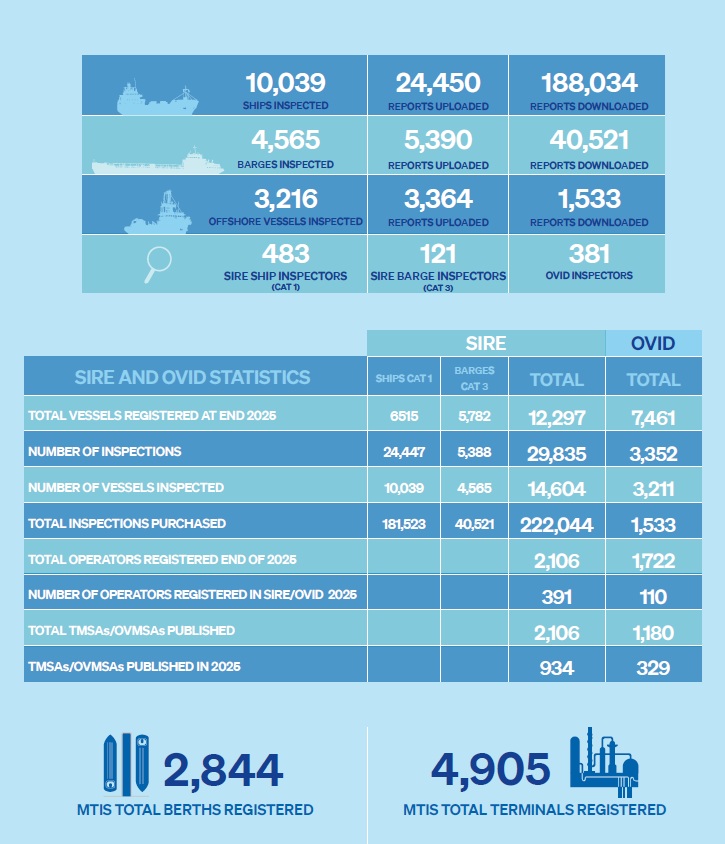
Launched in 2024, SIRE 2.0 set out to modernise inspections through digitalisation, greater data transparency and a stronger focus on human factors. Now, with more than 24,000 inspections completed, its impact is becoming clear, as it is not just a technical upgrade, but a broader cultural shift.
From paper to digital
Transitioning from a long-established paper-based system to a fully digital inspection regime has been a significant challenge. Connectivity issues, hardware variability, and the sheer scale of data management tested the industry’s adaptability.
But the biggest hurdle was cultural – changing habits built over decades. Despite these challenges, the level of engagement and industry’s willingness to adapt have been tremendous, resulting in a more transparent, efficient, and insightful inspection process.
Embedding preparedness through inspection
A central element of OCIMF’s response during 2025 was embedding security preparedness more deeply into marine assurance activity. In October 2025, OCIMF launched a Focused Inspection Campaign (FIC) under the SIRE 2.0 inspection programme to reinforce onboard readiness and crew familiarity with company security procedures.
The FIC introduced targeted questions on vessel hardening, access control and onboard awareness, applied across all SIRE 2.0 inspections regardless of a vessel’s operating area. By testing practical understanding rather than theoretical knowledge, the campaign aimed to ensure that security procedures could be applied effectively under real world conditions, including during periods of heightened stress or limited reaction time.
This approach reflected a broader shift away from checklist compliance towards behavioural assurance, aligning operational security with OCIMF’s wider emphasis on human factors. By examining how well crews understand and implement security plans, the inspection campaign sought to strengthen preparedness at the point where it matters most, on board the vessel.
Human factors at the forefront
The integration of human factors into inspections has been a major innovation. Guided by OCIMF’s Human Factors Committee, inspectors now look beyond compliance to understand why tasks are performed the way they are, considering fatigue, stress, and operational pressures.
This approach encourages inspections to turn into learning opportunities rather than simple audits. Early results are encouraging. There have been more open conversations on wellbeing and behaviour, which is vital for building trust and improving safety on board.
In an exclusive interview to SAFETY4SEA, Captain Dave Cudbertson, Programmes Director, OCIMF, also highlighted that inspectors are now encouraged to consider the pressures, fatigue and operational conditions that influence decision-making.
As mental health, wellbeing, and behavioural issues are complex and highly contextual, this approach requires inspectors to observe, engage and listen actively, rather than simply rely on checklist-based assessments.
Collaboration and continuous improvement
Feedback loops have been central to success. OCIMF actively engages with inspectors, operators, and charterers to refine the system. The Suggestions for Improvement (SFI) portal has become a key tool for users to share insights, ensuring SIRE 2.0 reflects real-world conditions. Continually optimising the system will enable it to leverage benefits and ensure lasting safety improvements.
Measuring success beyond numbers
While the number of inspections is significant, the true measure of success lies in the quality of insights generated. Dynamic, data-rich reports now help stakeholders anticipate risks rather than simply respond to them. OCIMF is also working to maintain data integrity across its global network of 460 accredited inspectors through structured question sets, mandatory evidence capture and rigorous quality assurance.
SIRE 2.0 was designed with flexibility, allowing future modules to address emerging priorities such as environmental performance, cyber resilience and autonomous systems.
Sustainability in the tanker sector should be viewed holistically – it concerns safety, people and performance as much as environmental impact. SIRE 2.0 is a powerful example of how digitalisation and data transparency can enable proactive decision-making, ultimately supporting safer and more sustainable operations.
OCIMF recognises that training based on the insights gained will be key, and additional training for members and inspectors will be provided in 2026.
"Success under SIRE 2.0 depends as much on transparency and adaptability as it does on technology. That shift in mindset has driven a more competent, confident inspection culture. " Captain Dave Cudbertson noted.
Source: Safety4sea
Robban Assafina is now on WhatsApp channel. Click Here


