Turning nuclear shipping technology into a dreadnought arms race with Beijing is the best way to ensure it never gets off the drawing board
What if the US could revive its moribund shipbuilding industry, spur investment in atomic energy, make ocean freight faster and cheaper, and eliminate one of the world’s biggest sources of carbon emissions — all at once? Better still, if it could poke China in the eye at the same time?
That is the vision behind a proposed renaissance of nuclear merchant shipping. The US government is planning to sign a public-private partnership with Core Power, a UK-based company planning to launch a nuclear-powered cargo ship in 2028, the Financial Times reported last week. Such vessels would “change the game and DOMINATE China,” US Secretary of Transportation Sean Duffy wrote on social media.
About 25 nations meeting at the International Atomic Energy Agency (IAEA) in Washington last month agreed to work on plans to allow uranium to power the sort of giant ocean-going vessels that ship toys, furniture, cars and raw materials around the world. China was not among them.That is a fatal omission. Nuclear merchant shipping is indeed an idea whose time has come, but turning it into collateral damage in the bathtub-battleship contest between Washington and Beijing is the surest way to ensure it never happens.
You cannot sensibly write the rules of nuclear merchant shipping to exclude the world’s biggest exporter, shipbuilder, container-port operator and producer of reactors. That is because the main barriers are not technological or even economic, but regulatory and political.
Consider how close we could be to a deal. No scientific breakthroughs are needed to make uranium-powered vessels work: Nuclear submarines have been plying the seas since 1955, and about 160 ships and submarines carry reactors. That is roughly equivalent to the 165 atomic power sites and the 150-odd research-reactor centers.
The economics remain to be proven, but could be compelling. Nuclear ships can steam far quicker than conventional ones, which typically slow down to conserve fuel. By a back-of-the-envelope calculation, an atomic vessel moving at 25 knots (46kph) could in theory carry 50 percent more containers between Rotterdam, Netherlands, and Shanghai than a conventional one traveling at 16 knots (30kph). Nuclear vessels might cost significantly more, but an operator would need far fewer of them, potentially bringing down the cost per container.
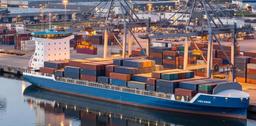
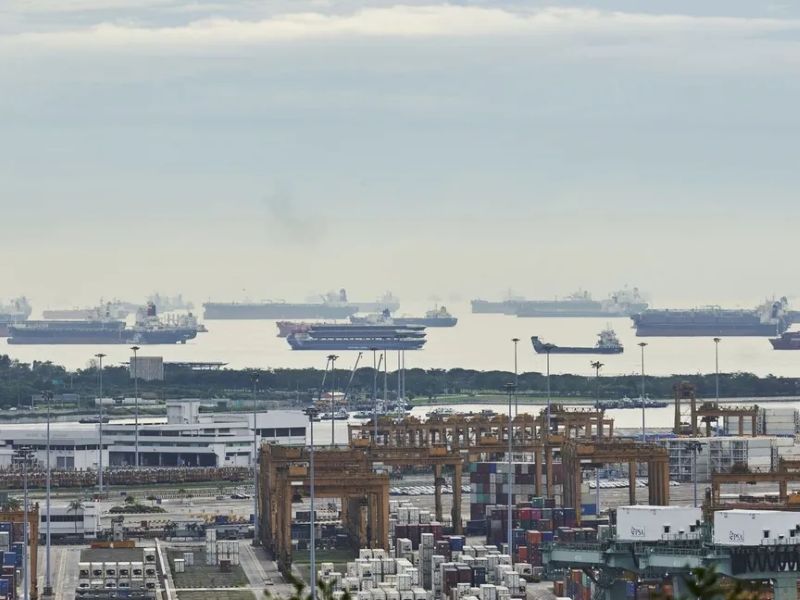
An atomic shipping industry could navigate around the world’s many anti-nuclear holdouts. An agreement would not need many countries to sign on. The world’s top 20 ports span just 11 countries and handle about half of all container traffic. The biggest ships are owned by a handful of companies in Switzerland, Denmark, France, China, Japan and South Korea. The industry itself revolves around a few global trunk routes such as Ningbo, China, to Long Beach, California, which feed traffic into smaller ports. You could probably replace the current generation of mega-container ships with a fleet of less than 500 nuclear vessels.
That might help the climate, too, especially if the smaller feeder vessels are battery-powered. The world’s ship fleet emits about as much carbon dioxide as the entire Japan. Nuclear-plus-batteries might not replace every vessel, but it is a plausible path to reduce the industry’s carbon footprint by more than two-thirds by my estimates.
However, regulation is where it gets fiendishly difficult. Almost all reactors now are either inside a sovereign state, or aboard a heavily armed military vessel. A nuclear merchant fleet would change that, putting hundreds of them into international waters vulnerable to pirates and armed groups. A conventional crew would need to expand to include a group of highly-trained, highly-paid nuclear engineers, plus potentially an armed security force to deter hijackers.
At that point, the legal, insurance and security landscape would look vastly different to what we have right now. Almost one-fifth of the container traffic at US ports is on Chinese-built vessels. Nervous at the prospect of a Chinese nuclear container ship docking in the port of Los Angeles? How about adding Chinese nuclear engineers and armed Chinese guards to protect its potentially hazardous power plant?
The problem is not intractable. At the height of the Cold War, then-US president Dwight D. Eisenhower negotiated with the Soviet Union to develop just such a set of international rules and inspections for civilian nuclear technology. The IAEA, which hosted last month’s meeting, ultimately grew out of those discussions. It has been largely successful over seven decades in turning nuclear technology from a weapons system into a civilian industry providing clean energy and medicine to benefit humanity.
Repeating that trick would require extraordinary levels of trust between the world’s major trading nations. However, such trust is increasingly scarce, and US President Donald Trump’s scattergun tariff wars are doing their best to undermine the little that remains. There is no plausible future for nuclear merchant shipping without China’s buy-in. Turning the technology into a dreadnought arms race with Beijing is the best way to ensure it never gets off the drawing board.
Source: Bloomberg
Robban Assafina is now on WhatsApp channel. Click Here