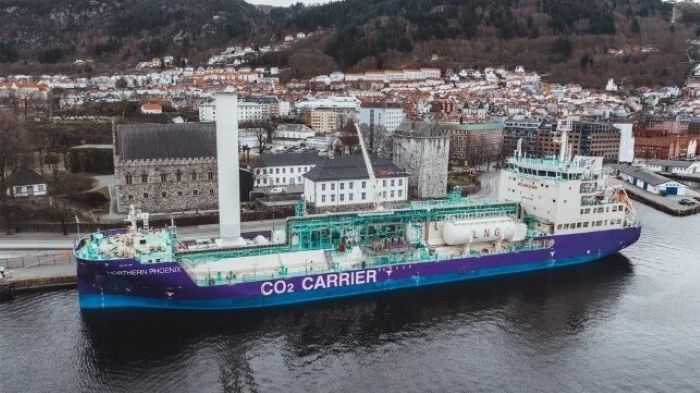
The first commercial cross-border carbon transport and storage program, Norway’s Northern Lights, is moving forward with its announced fleet expansion as it completed a second charter agreement with MISC Group and K Line (Kawasaki Kisen Kaisha). This follows the January 2026 announcement that the company would add four more vessels and the recent delivery of its newest ship to Bernhard Schulte Shipmanagement.
Northern Lights was started in 2021 as a joint venture between Equinor, Shell, and TotalEnergies in support of Norway’s Project Longship, a government-led full-scale carbon capture and storage initiative. The company received its first vessel in late 2024 and commenced operations in 2025. It transports liquified CO2 captured from industrial sites to a receiving terminal in western Norway and then pumps it through a pipeline for permanent storage in a reservoir 2,600 meters under the seabed.
The project has already entered into contracts to transport and store CO2 from Norwegian industries, including Heidelberg Materials’ cement factory in Brevik and the Hafslund Celsio’s waste-to-energy plant in Oslo. In addition, the Northern Lights JV has signed commercial agreements with Yara in the Netherlands, Ørsted in Denmark, and Stockholm Exergi in Sweden.
Starting with an initial CO2 capacity for transport and storage of 1.5 million tons, Northern Lights announced last year that it was proceeding with an expansion. It plans to reach a capacity of more than 5 million tons per year from the latter half of 2028.
The first two vessels, Northern Pioneer and Northern Pathfinder, were joined in April 2026 with the christening of Northern Phoenix. The third vessel is dedicated to transporting CO2 from Yara and will play a key role in enabling the start of commercial cross-border operations.
The first three vessels are managed by K Line, while the fourth ship, Northern Purpose, was delivered in May and is owned and operated by Berhard Schulte. It will be used to transport LCO2 from industrial customers in Northwest Europe to Norway.Northern Lights conducted a tender for the addition of the four vessels. Northern Lights, MISC, and K Line reported that they have now completed the second of two additional charter agreements for new vessels. The two ships, which will be built at Dalian Shipbuilding in China, will be owned by the MISC-K Line joint venture. The contract for the first vessel was completed in March, and the second contract in May.
These ships are in addition to two that have also been contracted with Japan’s Mitsui O.S.K. Lines. MOL’s two ships will be built by HD Hyundai Heavy Industries. Northern Lights has said it expects the new vessels to begin delivery in the second half of 2028, and deliveries will continue into 2029.
The first four vessels built in China have a capacity of 7,500 cbm distributed in two cylindrical pressure tanks. They are engineered to handle the LCO2 at low temperature and medium pressure. The ships have LNG dual-fuel propulsion with wind assistance from a rotor. They also employ air lubrication under the hull.Reflecting the growth in LCO2 transport and storage, Northern Lights has reported that the next four vessels will each nearly double capacity to 12,000 cbm. They will also use LNG dual-fuel propulsion.
Other carbon capture projects are continuing to develop, with other vessels also being built for the new sector. Royal Wagenborg reported at the end of March that its vessel Carbon Destroyer 1 (5,000 cbm) had completed sea trials and was moving to the final phase of commissioning together with the onshore and offshore systems for Denmark’s Project Greensand. Once operational later this year, the Carbon Destroyer 1 will begin regular shuttle operations between Denmark and the Nini field. Unlike the Northern Lights vessels, it is designed for a 36?hour shuttle cycle and will directly support the pumping of the CO2 into the under seabed storage. The ship will be able to transport approximately 600,000 tonnes of CO? per year.
Source: The maritime executive
Robban Assafina is now on WhatsApp channel. Click Here