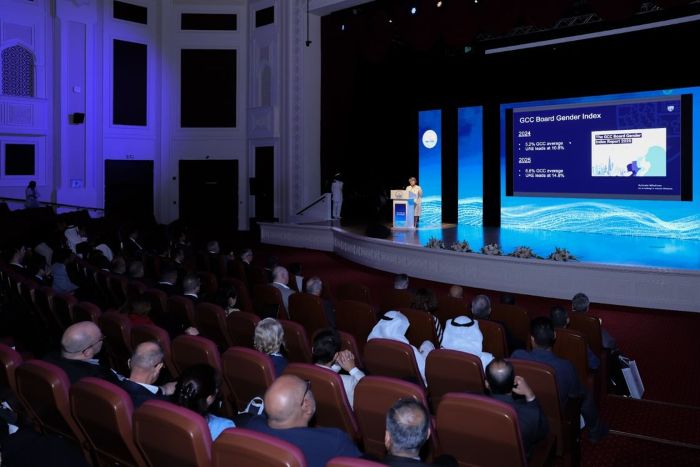
The Sharjah Maritime Transport Academy organized the second session of the International Maritime Research, Education and Training Conference “IMRET 2026”, with the participation of a select group of international academics, specialists and researchers in the maritime sector, in support of the global dialogue on maritime sustainability, keeping pace with changes, the blue economy and governance of the maritime sector.
The conference aims to provide a specialized international platform that brings together academics, researchers, decision-makers and leaders of the maritime sector to discuss current challenges and anticipate future solutions that contribute to the development of the maritime sector and enhance its environmental, operational and regulatory readiness through knowledge exchange and the building of institutional partnerships.
Simantak Bhattacharya, Deputy Director for Academic Affairs at the Sharjah Maritime Academy, affirmed his strategic vision regarding the Academy’s role in developing maritime education and research, saying: “At the Sharjah Maritime Academy, we are committed to enhancing our position as a leading platform for maritime excellence through innovative education, research focused on future solutions, and international partnerships that contribute to preparing future leaders capable of meeting the challenges of sustainability, readiness, and adaptation in the global maritime sector.”
Professor Heather MacGregor, President and Vice-Chancellor of Heriot-Watt University Dubai, highlighted the importance of empowering women and their leadership role in the fields of maritime education and research, reviewing the topic of the “glass ceiling” as a challenge that still exists in the 21st century for many ambitious women, and is of increasing interest in the maritime sector, which seeks to achieve diversity and inclusion as pillars of sustainable growth, readiness and responsiveness in the industry of the future.
The first session of the conference witnessed a pivotal focus on the topic of cooperation, readiness and response in education and maritime operations. It began with the ideas of Dr. Ana Sleshkovic, a professor at the University of Zadar, who presented an integrated vision to enhance the well-being of seafarers and the health of the maritime workforce, going beyond the traditional stress management framework to building more supportive and sustainable institutional and health structures in the maritime work environment. This was followed by a presentation by Captain Matthew Shank, Chairman of the Maritime Search and Rescue Council, in which he highlighted the importance of developing autonomous systems at sea and strengthening search and rescue and emergency response mechanisms, especially in light of the increasing challenges facing the global maritime sector.
Student research stood out at the conference, with students Fares Al Mazrouei and Mahmoud Qadkhodaei from the Sharjah Maritime Academy presenting an innovative proposal for a mental health support framework for naval recruits in the United Arab Emirates. This reflects the academy’s strong focus on applied research and encouraging student participation in addressing practical issues in the maritime sector.
Dr. Emeric Lindjell from Paris 1 Panthéon-Sorbonne University, a prestigious research university in France known for its long history in the humanities, social sciences and global higher education, provided insights on traditional maritime trade and its economic aspects. Dr. Krishna Prasad, a director at Aster Marine Cargo LLC, which specializes in maritime transport and logistics, shared an analysis of the commercial, safety and security aspects of sailing ship transport and wider maritime transport, thus contributing to enriching the discussion on the challenges and opportunities in maritime logistics chains at the regional and international levels.
In the second session, Mr. Naveen Kumar, Director of Maritime Research at Drury Foundation, reviewed sustainable maritime practices and the prospects of the evolving blue economy. Dr. Akanksha Bhatura, Executive Director at Sinoda Shipping, gave an in-depth presentation on digital transformation as a strategic driver to enhance the readiness and responsiveness of modern maritime supply chains, emphasizing the importance of technology in supporting the efficiency and sustainability of maritime logistics operations.
Captain Marion Benales gave a lecture at the Sharjah Maritime Academy on the human and social impacts of the green transition in the maritime sector, highlighting the choices and challenges facing workers and maritime communities in light of global environmental changes.
Other participants addressed several vital topics, including the role of ports as key hubs in the development of the blue economy and the potential for relying on ammonia as an alternative fuel from an operational and safety perspective, in addition to advanced engineering improvements in micro-layer structures presented by Captain Mahmoud Metwally and Mr. Prasad Niak from Anglo-Eastern Ship Management and Dr. Saad Al-Wassada, Associate Professor at the Sharjah Maritime Transport Academy, contributing to enriching the dialogue on innovation and development in the maritime industry.
The conference concluded with a keynote address by Captain Kuba Szymanski, Secretary General of the International Association of Shipmasters, who reviewed whether maritime transport is keeping pace with broader global trends. This was followed by closing remarks by Professor Emma Northam, Dean of Research and Development at the Academy, followed by networking activities, a student scientific poster competition, and a tour of the Sharjah Maritime Academy facilities.
During the IMRET 2026 conference, the Sharjah Maritime Academy launched the "Sea. Impact" initiative, a sustainability initiative that honors the speakers at the conference not only with words but also with an impact certificate, whereby a mangrove tree will be planted on behalf of each speaker in a direct contribution to the protection and restoration of marine ecosystems. Each certificate includes a QR code through which its holders can view the location of their tree in the Kalba Reserve in Sharjah and follow its journey and growth over time.
The “Sea. Impact” initiative transforms appreciation into responsibility and recognition into action. It reflects the Academy’s commitment to sustainability in a tangible way, in line with the values and goals of long-term sustainability, which are based on protecting marine environments in the United Arab Emirates and engaging students in environmental research and sustainability projects.


.jpg&w=256&q=75)