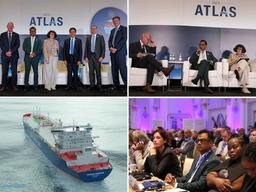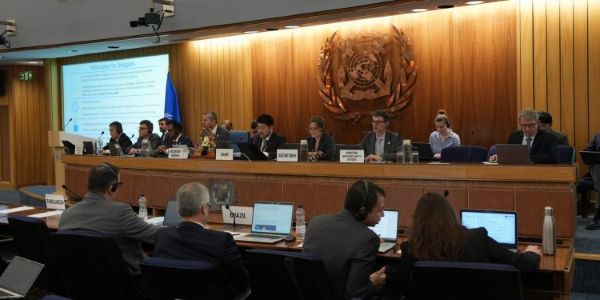
The International Maritime Organization’s (IMO) Sub-Committee on Ship Systems and Equipment (SSE) met for its twelfth session at IMO Headquarters in London from 9 to 13 March.
Several discussions focused on the progress on future safety rules for fire protection, lifesaving equipment and new energy technologies on ships. Many of these changes are still being developed and could enter into force around 2032 after approval and adoption by the Maritime Safety Committee (MSC).
Key outcomes of the SSE 12
Draft amendments to SOLAS regulations II-2/3 and II-2/9 were finalised following the review of SOLAS regulation II-2/9 on “Containment of Fire” to incorporate existing guidance and clarify requirements. Expected to go to MSC 112 (December 2026) for approval and at MSC 113 (2027) for adoption.
A proposal to modify the “Temperature cycling test – test data” sheets to confirm exposure of prototype samples to ordinary room temperature conditions between the hot and cold cycles of LSA, and to record the associated information, was finalised. Draft amendments to MSC.1/Circ.1628/Rev.4, MSC.1/Circ.1629, MSC.1/Circ.1630/Rev.3 and MSC.1/Circ.1633 will go forward for approval to MSC 112.
New requirements for ventilation of partially enclosed lifeboats. Work continued on the development of the requirements, with entry into force expected on 1 January 2032.
Revision of SOLAS Chapter III and the LSA Code. The sub-committee continued to develop goal-based amendments to SOLAS Chapter III and the LSA Code.
Amendments to SOLAS Chapter III and Chapter IV of the LSA Code to require the carriage of self-righting or canopied reversible liferafts for new ships. Work continued on the development of draft regulations, with further work expected and entry into force anticipated on 1 January 2032.
Comprehensive review of Resolution MSC.402(96). Limited progress was made in reviewing the requirements for maintenance, thorough examination, operational testing, overhaul and repair of lifeboats and rescue boats, launching appliances and release gear.
Work continued on the development of amendments to SOLAS Chapter II-2 and the FSS Code concerning detection and control of fires in cargo holds and on the cargo deck of containerships. Draft amendments to SOLAS Chapter II-2 on water mist lances and portable infrared thermal imagers were progressed along with supporting draft guidelines.
Work continued on the evaluation of the adequacy of fire protection, detection and extinction arrangements in vehicle, special category and ro-ro spaces to reduce the fire risk of ships carrying new energy vehicles.
A draft work plan was developed to consider safety regulations for the following alternative fuels and new technologies:
- Methyl/ethyl alcohol fuels
- Fischer-Tropsch (FT) diesel
- Lithium-ion batteries
- Supercapacitor energy storage technology
- Swappable traction lithium-ion battery containers
- Advanced waste heat recovery.
- Life-saving Appliances (LSA)
- New requirements for ventilation of partially enclosed lifeboats
Draft amendments to the following were progressed:
- Chapter IV of the LSA Code
- The Revised recommendation on testing of life-saving appliances (resolution MSC.81(70))
- Partially enclosed lifeboats will need to have sufficient ventilation to limit CO₂ concentration within the lifeboat to 5,000 ppm with the entrances closed, taking account of the number of people the lifeboat is certified to carry.
This will need to be achieved by forced/mechanical ventilation at a rate of 5 m³/hour/person for a minimum of 24 hours; or by using ventilation openings at each end of the boat and as high as possible with a cross-section area of at least 0.015 m³/person; or any other suitable arrangement to prevent a CO₂ concentration of more than 5,000 ppm.
This is expected to apply to partially enclosed lifeboats installed from 1 January 2032.
SSE 12 instructed the correspondence group reporting to SSE 13 (2027) to draft consequential amendments to MSC.1/Circ.1630/Rev.3.
Revision of the 2010 FTP Code to allow for new fire protection systems and materials
The 2010 FTP Code and relevant fire test procedures therein were reviewed to allow for new fire protection systems and materials to be included.
It was agreed that:
- SOLAS regulation II-2/9.3.1 is not an appropriate location for addressing the application of plastic pipes.
- The unified interpretation of SOLAS regulation II-2/9.3.1 in MSC.1/Circ.1120 has served its purpose and will become obsolete after the adoption of the revised FTP Code.
The following were developed:
- Draft amendments to the 2010 FTP Code to introduce tests for plastic pipes in annex 1, part 6, making a footnote reference to paragraph 2.2 of the Guidelines for the use of plastic pipes on ships (A.753(18)).
- Given the non-mandatory nature of the FTP Code and that plastic pipes are not addressed in SOLAS, it was noted that a specific SOLAS amendment on the application of plastic pipes would be needed for the new draft requirements to become mandatory.
Draft amendments to the 2010 FTP Code to introduce tests for “H” class divisions in annex 1, part 3, including application requirements and performance criteria.
Due to time constraints, the work will be continued by correspondence with the following expected to be further developed:
- draft amendments to the 2010 FTP Code for the following:
– introduce tests for “H” class divisions in annex 1, part 3
– multipurpose penetrations/transits; and
– horizontal A-class hatches;
- consequential draft amendments to paragraph 1.3.26 of the 2009 MODU Code on the “H” class divisions.
It is anticipated that the draft amendments will enter into force from 1 January 2032.
Development of a safety regulatory framework to support the reduction of GHG emissions from ships using new technologies and alternative fuels
MSC 110 discussed the assignment of work to sub-committees and a work plan including timelines, tasks and priorities for the development of a safety regulatory framework to support the reduction of GHG emissions from ships using new technologies and alternative fuels.
SSE was tasked with addressing the safety aspects of the following alternative fuels and new technologies and developing a work plan for developing standards for:
- Methyl/ethyl alcohol fuels;
- Fischer-Tropsch (FT) diesel;
- Lithium-Ion Batteries;
- Supercapacitor Energy Storage technology;
- Swappable traction lithium-ion battery containers; and
- Advanced Waste Heat Recovery.
It was confirmed that priority should be given to the development of draft interim guidelines for the safety of ships using battery energy storage systems (BESS: Lithium-Ion Batteries, Supercapacitor Energy Storage technology and Swappable traction lithium-ion battery containers).
They should cover all BESS, not just those related to Lithium-Ion Batteries, and should be goal based to allow for new technologies. It was agreed that the work on BESS will be transferred to the SDC sub-committee.
A draft work plan was developed including the following key milestones:
- SSE 13 (2027) – Within the FSS Code, develop or identify appropriate standards for system certification of water-based and gas-based fire-fighting systems to extinguish alcohol fires, for approval at MSC 115 (2028) and subsequent adoption by MSC 116 (2029).
- SSE 14 (2028) – Develop amendments to SOLAS chapter II-2, part B, and amendments to the Guidelines for measures to prevent fires in engine-rooms and cargo pump-rooms (MSC.1/Circ.1321), as appropriate, to include safety requirements addressing the risk posed by Fischer-Tropsch (FT) diesel fuel having an autoignition temperature (208°C) below the allowed surface temperature in SOLAS, for approval at MSC 116 (2029) and subsequent adoption by MSC 117 (2030).
- SSE 15 (2029) – Develop the interim guidelines on safety requirements for advanced waste heat recovery systems that, as a minimum, address the risks of possible flammability and toxicity hazards due to the circuit media used in the system, taking into account the flashpoint of the circuit media, for approval at MSC 118 (2030)
Robban Assafina is now on WhatsApp channel. Click Here