
INTERCARGO has published its latest Bulk Carrier Casualty Report, providing a comprehensive review of bulk carrier safety performance over the 2016–2025 period and highlighting key casualty trends.
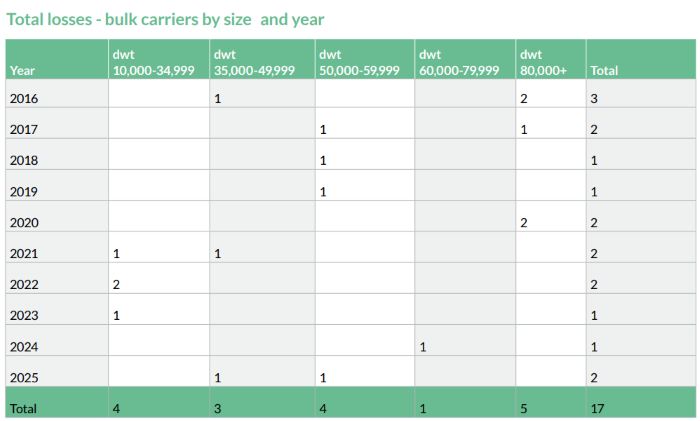
The report examines the safety performance of bulk carriers over a rolling 10-year period in order to identify risks and improve safety for seafarers and vessel operations. The new edition of the Bulk Carrier Casualty Report (2026) reveals that between 2016 and 2025, 17 bulk carriers of more than 10,000 deadweight tons (dwt) were reported lost, with the tragic loss of 71 seafarers’ lives.
Analysis of total losses from 2016 to 2025
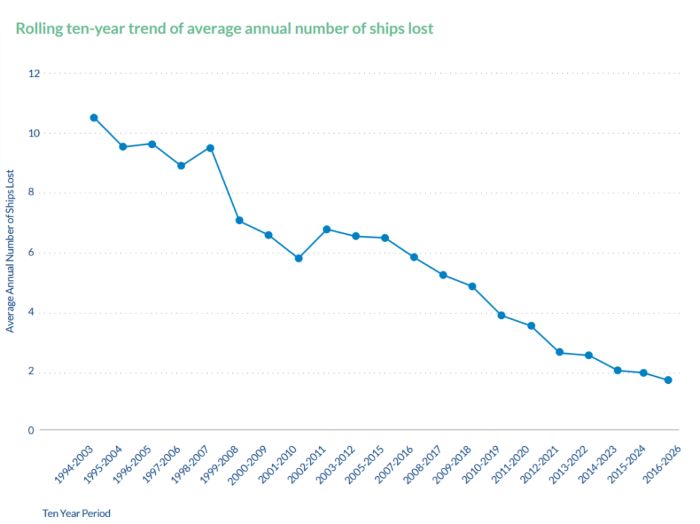
Analysis of data from 2016 to 2025 demonstrates a consistent decline in the rolling 10-year average of vessel casualties.
This downward trend in bulk carrier losses indicates sustained improvement in maritime safety performance.
Credit: INTERCARGO
These statistics and trends can also be set against a backdrop of a significant growth in the global bulk carrier fleet 2016-2025. Industry figures show that the global bulk carrier fleet has seen significant growth in the years since 2013. About 10,400 bulk carriers were operating in 2013. That figure had grown to 13,669, according to the MIS data, by December 2025, against 12,544 by December 2024.
Annual casualties compared with the global total number of bulk carriers over 10,000 dwt have continued at a low level since 2018. This improvement is particularly noteworthy given the challenging operational environment, which includes increased trade volumes, port congestion, fleet age profiles, and adverse weather conditions.
The progress can be attributed to enhanced safety protocols, including crew training programs, advanced vessel design, technological innovation, and strengthened regulatory compliance.
Nevertheless, continued vigilance remains essential, particularly regarding cargo liquefaction risks, cargo shifts and safe navigation with the emphasis on berth to berth passage planning.
Losses in numbers
- 17 bulk carriers over 10,000 dwt have been identified as lost, an average of 1.7 per year
- 71 crew members lost their lives as consequence, or on average seven fatalities per year
- The average age of the bulk carriers lost was 18.1 years
- Vessels amounting to 1.63 million dwt in total have been lost, an average 163,030 dwt per year
- Cargo liquefaction remains the greatest contributor to loss of life, accounting for 37 lives or 52.1% of the total loss of life in the past ten years.
- Groundings remain the greatest cause of ship losses, with seven losses or 41.1% of the total.
- Four flooding casualties (23.5% of the total) cost 34 lives – a significant 47.9% of the total number of lives lost.
- The average life loss per ship casualty was 4.18 during the ten-year period between 2016 and 2025, 4.45 between 2015 and 2024, 4.24 between 2014 and 2023, 4.00 between 2013 and 2022, and 3.41 between 2012 and 2021. This compares to 3.56 during 2011 and 2020.
Credit: INTERCARGO
Significant findings
10,000-34,999 dwt: four ships were lost, accounting for 23.5% of the total 17 casualties reported. These casualties cost 12 lives, or 16.9% of the total.
50,000-59,999 dwt: four vessels lost in this range accounted for the most loss of life, with 37 seafarers losing their lives, accounting for 52.1% of the total of 71 lives during the period.
80,000+ dwt: five ships were lost accounting for 29.4% of the total 17 casualties, with 22 seafarers losing their lives, or 31.0% of the total.
In 2020, one Capesize and one VLOC vessel (Wakashio and Stellar Banner) were lost drawing attention on large bulk carrier safety.
The lowest number of one casualty occurred in the 60,000-79,999 dwt, and three casualties in the 35,000-49,999 dwt ranges. There was no life lost as a consequence of those ship losses.
10-year data reveal safety gaps
Initial analysis of the statistics of the 10-year bulk carrier casualty data reveals some potential safety gaps, such as:
Cargo liquefaction remains the greatest contributor to loss of life, accounting for 37 lives or 52.1% of the total loss of life in the past ten years:
- 2 casualties, Iron ore fines of India, with the loss of one life
- 8 casualties, Nickel Ore of Indonesia, with the loss of 119 lives
- 1 casualty, Bauxite of Malaysia, with the loss of 18 lives
- 1 casualty in 2026, Nickel Ore of the Philippines, with the loss of six lives
2. Groundings remain the greatest cause of ship losses, with seven losses or 41.1% of the total.
3. Four flooding casualties (23.5% of the total) cost 34 lives – a significant 47.9% of the total number of lives lost.
Key observations
- Continuous lessons from incidents highlight the need for more frequent updates to cargo schedules, especially to address new commodities and changing cargo characteristics.
- There is a growing demand for clearer and more prescriptive requirements covering moisture testing, sampling procedures, and accurate shipper declarations of cargo properties.
- Stronger compliance is essential, supported by more robust enforcement from flag and port States, targeted inspections of high-risk cargoes, and mandatory training for both ship and shore personnel.
- Improved transparency, data sharing, and casualty investigation feedback are critical for continuously refining the IMSBC Code and embedding lessons learned into industry practice.
- Reducing bulk carrier groundings depends on better navigational practices, enhanced voyage planning, and effective operational oversight.
- Effective use of navigational tools such as ECDIS, along with timely navigational warnings, significantly improves situational awareness during navigation.
- Strong bridge resource management, well-trained crews, and clear procedures for monitoring vessel position are essential, particularly during coastal navigation and port approaches.
- Shore management involvement, including passage plan reviews and incorporation of lessons learned, helps identify and mitigate navigational risks before they escalate into incidents.
- Overall bulk carrier safety improvements rely on continuous learning, better training, improved ship design, technological advancement, and stronger regulatory compliance.
- The ultimate industry goal is zero loss of seafarers’ lives and zero loss of dry bulk ships, requiring coordinated action from all stakeholders.
In the beginning of 2026, the bulk carrier industry was saddened by the loss of the 56,000-dwt, 2013-built bulk carrier Devon Bay (IMO No. 9622849). Two seafarers have lost their lives and as of 22 January 2026, four seafarers are still missing. The vessel was carrying a cargo of nickel ore at the time of incident.
In 2024, three bulk carriers were lost in the Red Sea and Gulf of Aden (GOA) and in 2025 two more were lost together with the loss of 8 seafarers and many injuries, as the direct consequence of missile, drone and drone boat attacks by the Houthis.
"INTERCARGO strongly condemns all attacks on bulk carriers in the Red Sea and Gulf of Aden (GOA) regions which directly contravene the fundamental principle of freedom of navigation "… said the organization in the publication.
To remind, to address security concerns, in late May, ICS, BIMCO, INTERCARGO, INTERTANKO, IMCA, and OCIMF joined forces to issue the “Safe Management of Vessel Transit through the Strait of Hormuz” guidance, to help operators safely transit the area.
Source: Safety4sea
Robban Assafina is now on WhatsApp channel. Click Here


